Check your resume wording against the job posting.
See which of the posting's requirements your wording already answers, and whether your text reads cleanly.
Resume text preflight
Computed here, in this tab
Select all in your resume, copy, paste here.
Add it to also check job-language coverage.
No score, and no upload.
Your findings appear here when you check the text.
What this check tells you, and what it does not
A percentage would be a number about this checker rather than about any employer's system, so what you get instead is the requirement your wording already answers and the one it does not.
This check, in your browser
- Reads your pasted text the way a parser would. It tells you whether the standard headings are there and whether the content comes through as readable text.
- Holds the posting's requirements against your wording and lists what is answered, what is close, and what has no evidence yet.
- Produces no percentage. A match score would measure this tool, not any employer's system. Nothing you paste leaves this tab.
After you sign up
- Your resume is composed from the record you approved, so the wording is written to the posting rather than graded after the fact.
- The finished PDF and DOCX are format-checked after rendering: text is extracted back out of the file and compared with the document before you can download it.
- Still no score, for the same reason.
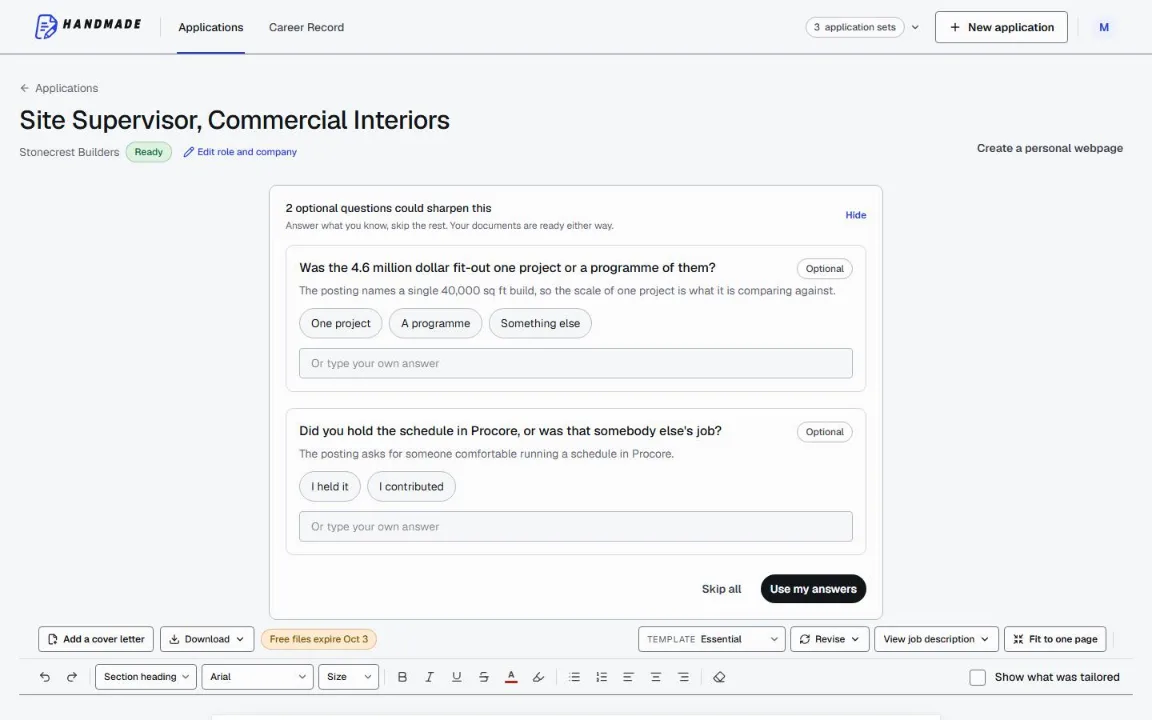
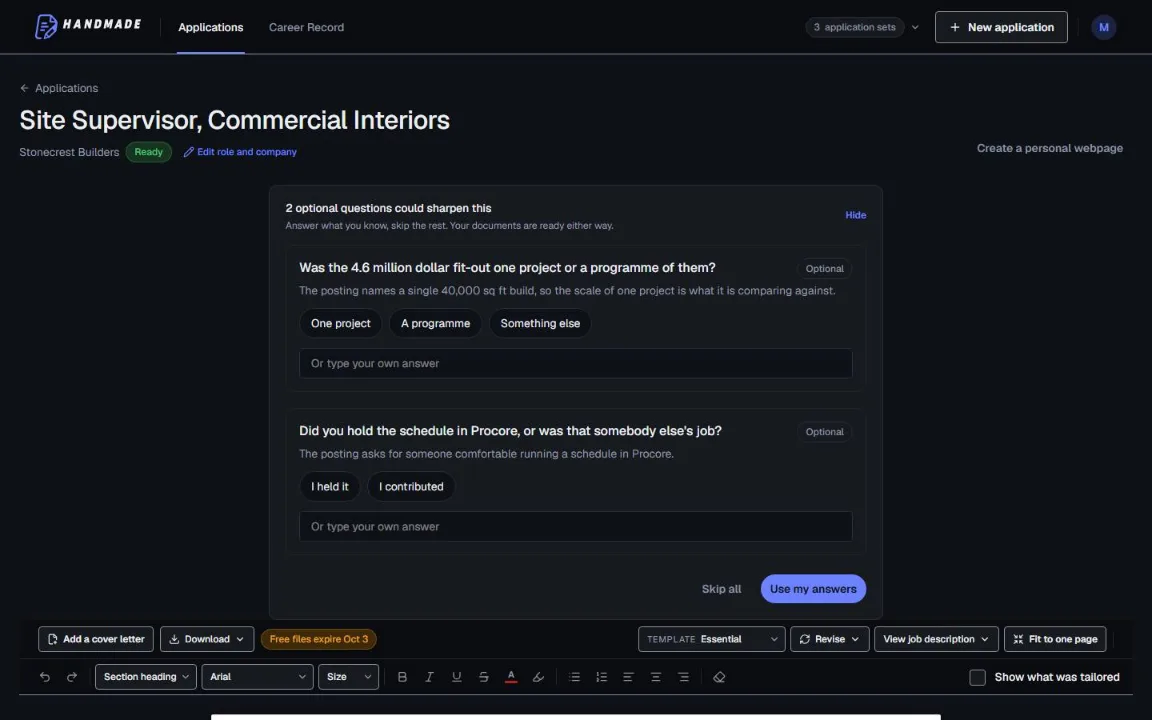
Paste, read, fix
Paste your resume text
Straight from the document you already have. Nothing needs to be uploaded to see the wording check.
Paste the job description
We pull the requirements out of it and hold each one against the language already in your text.
Fix the wording that is genuinely yours
Where the posting asks for work you have done but your resume says it differently, change the wording. Where you have not done it, leave it out. Stuffing in words you cannot back up gets you into interviews you cannot finish.
See the gaps before an employer does.
Hold the posting up against your own words, fix what is genuinely yours to fix, and export a format-checked file.
2 complete application sets free, at the same quality as a paid plan. No card required.
ATS implementations vary. We say ATS-friendly, parse-checked, and format-checked, never ATS-proof, and we do not sell match scores or guaranteed rankings.