Handmade Webpage

Your finished resume, with a public home.

A Handmade Webpage publishes a resume you have already finished here, so the resume comes first — there is no separate page to write. One page per account, free on every plan.

2 complete application sets free, at the same quality as a paid plan. No card required. Plans from $19.99.

yourname.handmaderesume.com

One page per account · free on every plan · private to search engines by default

See one rendered by the real page system

Why a link beats an attachment

A resume gets forwarded, printed, and re-saved, and every copy drifts a little further from the one you approved. A link is the version you keep control of: it shows the resume you actually finished, it opens on a phone without a download, and it can be taken down. That is the whole reason this exists: not to replace the file you send, but to give it an address.

It is deliberately not a portfolio builder or a personal CMS. One page, no blog, no site builder, no visitor metrics for you to check. The narrow scope is the point: a page that has to stay true to your resume needs to be small enough that it cannot drift away from it.

How it works

Resume first, then a page.

  1. Approve your career record

    Upload a resume, paste one, or build from scratch, then approve the facts once. Everything downstream is limited to what you approved.

  2. Finish one tailored resume

    Take one application through to a finished, checked resume. That version is the only thing a page will accept as its source, so this step is the real prerequisite, not payment.

  3. Choose a name and a design

    Claim an available name-based address, preview the designs with your own content, and choose exactly which contact fields are public.

  4. Preview, then publish

    You see the real renderer before anything goes live: the same one a visitor gets, not an approximation. Publish when it looks right, and unpublish whenever you want.

The prerequisite, stated plainly
Take one application through to a finished resume before a page can be created. If you arrive without one, you land on your applications to make one — not on an empty publish screen. The free start is enough to get there.
Updates stay deliberate
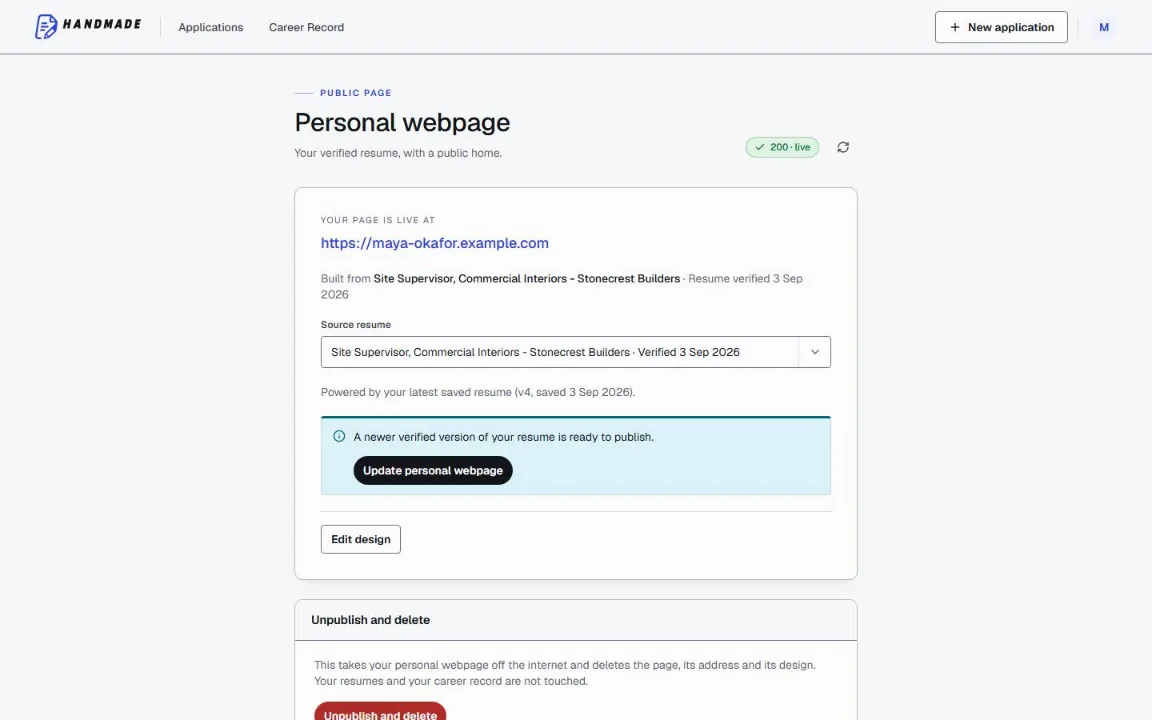
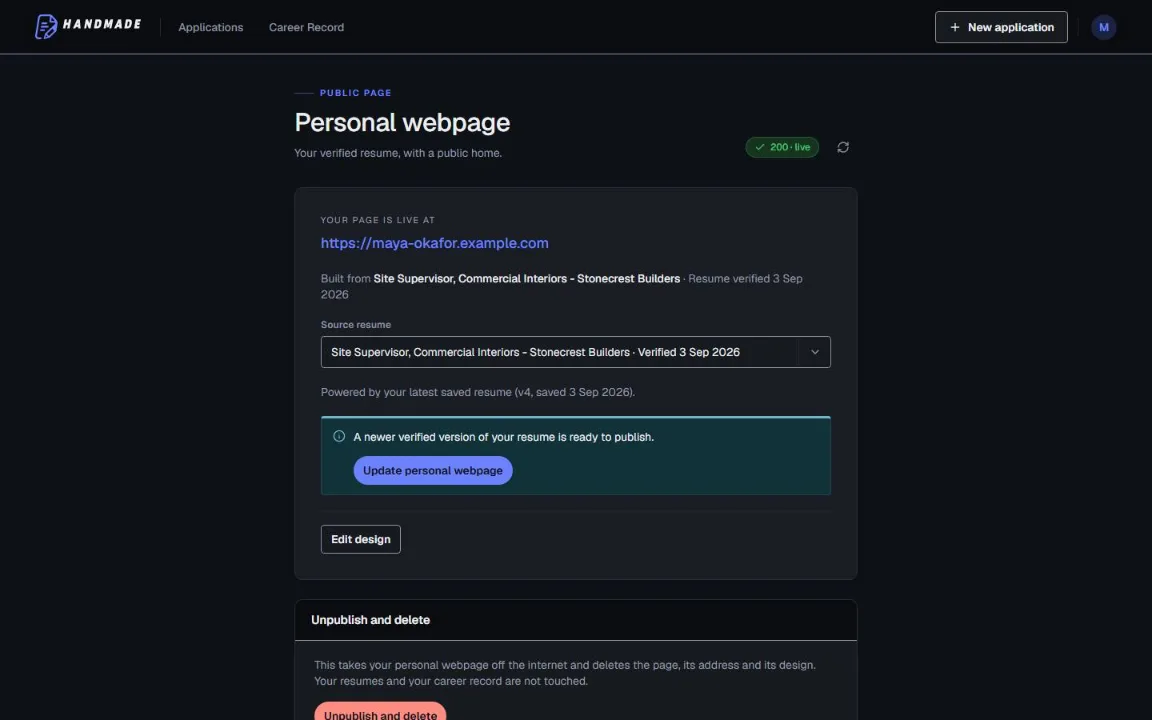
Saving a resume edit never touches your live page. An update becomes available once the new version has passed its checks, then rebuilds the page in the design you already chose.
Server-rendered, not an app
The page is plain HTML and CSS built on the server. Its designs are compiled in statically, so the published content ships no scripts of its own and there is nothing to hydrate before a visitor can read it.
A copy, not a second draft
Most resume-website tools ask you to re-enter your career into a new editor, which then quietly drifts from the resume you actually send. Here the page is built from one finished resume, so it cannot diverge on its own. Change the resume and the page can be rebuilt from it; nothing is written fresh for the web.
A finished catalog, not a template dump
The gallery offers 10 designs today, and only a design whose renderer has actually shipped can be chosen. An unfinished one cannot reach a published page. Each is paired with palettes whose body text, muted text, and accent were each contrast-checked against their own background before release. Switching design re-themes the same content and never rewrites a word of it.
What publishing does not do
It creates no new deployment, no DNS record, and no second account. Your page is served by the same application as the rest of the product, the public endpoint behind it returns only the page's own content (no record ids, no job description, no review detail), and unpublishing takes it down.

Finish one resume, then give it an address.

The page is built from a resume you completed here, so that comes first. Publishing it afterwards is free and takes a minute.

One page per account, free on every plan, and private to search engines until you choose otherwise. A page can only be built from a resume version that has already passed its checks, so a finished resume comes first. Your page carries a small "Made with Handmade Resume" credit, and the address depends on the name you want being available.

Questions about the public page.
Do I need a finished resume first?

Yes, and this is the one real gate. A page is built from a resume version that has already passed its checks, so you take one application through to a finished resume before a page can be created. The free start — 2 application sets — is enough to get there.

Does a Handmade Webpage cost extra?

No. One page is included on every plan, including the free one, and creating, publishing, or updating it never spends an application.

How many designs can I choose from?

10 today. The gallery lists only designs whose renderer has shipped, so you can preview every one of them with your real content before committing, and switching later re-themes the same content without rewriting it.

Will my page show up in search results?

Only if you decide it should. Pages start noindex, and indexing is an explicit switch you control. Unpublishing takes the page down entirely.

Can I use my own domain?

Not today. Pages are served on a name-based address under the page domain, and publishing creates no DNS record of its own.

What happens when I edit my resume?

Nothing, until you say so. A save never touches the live page. Once the new version has passed its checks, an update becomes available and rebuilds the page in the same design you chose.