How to use a master resume for multiple applications
Keep one complete record of your real work history, then build a focused resume per job from it.
6 minute readPublished Updated
Short answer
Keep one private document holding everything true about your work, and stop editing last week's application into this week's. Each resume you send is then a fresh selection from that single source rather than a copy of a copy. Review it properly once and the per-application fact-checking mostly stops being a job.
Do this next
- Start one file and pour in every role, project, tool, credential, and result.
- Beside each result, note what was measured and over what period.
- Settle the dates, titles, and conflicting numbers once, then trust the file.
- Build each application by selecting from it, never by editing the previous send.
- Keep the posting text and the exact files you sent, filed by application.
The version-chaos problem
Most active job seekers end up with a folder of near-duplicate resumes: Resume_v7_final_FINAL. Each was edited from another under deadline pressure, and no one remembers which claims were tightened, stretched, or dropped where. When an interviewer reads back a line from the version you sent them, you need to know it is true and why it says what it says.
The master resume pattern solves this by separating the source of truth from the documents you send. You maintain one comprehensive record; every outgoing resume is a fresh selection from it, not an edit of a previous edit.
Make the master comprehensive, not pretty
The master is a private working document. Include everything true and potentially useful: every role with full accomplishment lists, projects that did not fit anywhere, certifications, tools, metrics with their context. Length does not matter; nobody sees it but you.
Write accomplishments with their evidence attached where you can (what was measured, over what period, verified how). Future you, tailoring at speed, will trust the entry because past you recorded its basis.
Career Inventory Builder
Tick the kinds of evidence you have. Get a section-by-section checklist of what to gather before you build one master record.
Which of these do you have to draw from?
Approve once, then reuse
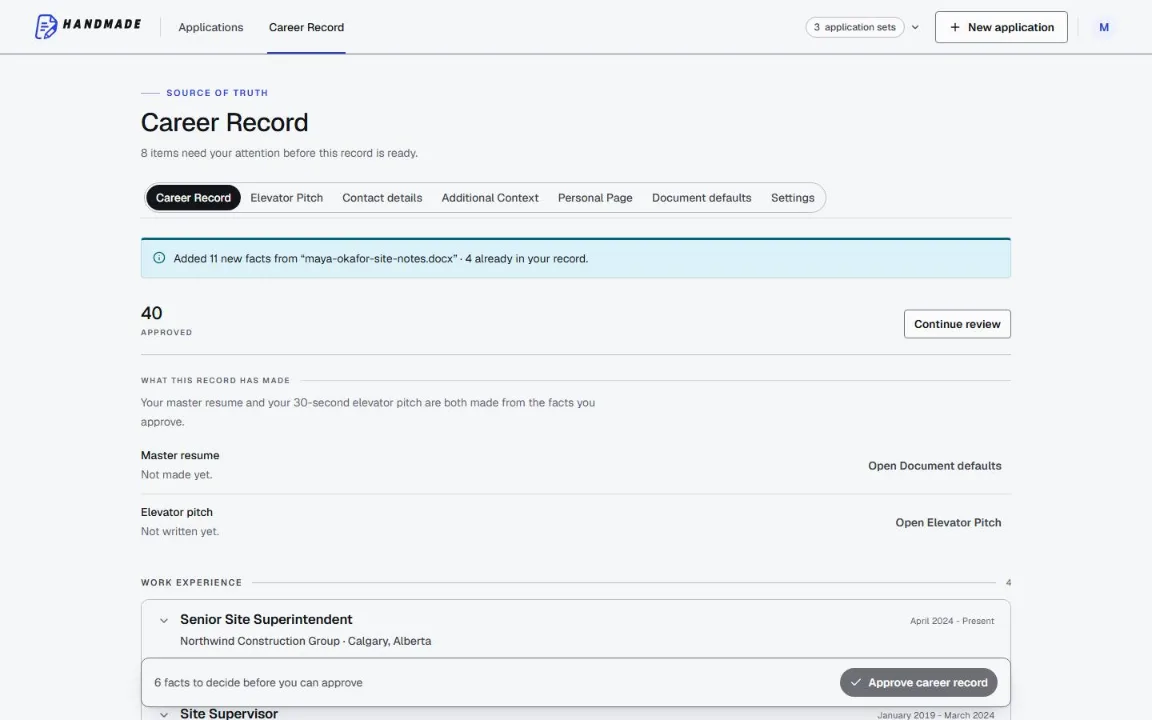
The master only works if it is reliable, so review it once, properly: normalize date formats, fix titles, confirm numbers, and resolve conflicts between old versions. From then on, tailoring is selection and rewording, and the truth-checking has largely already happened.
This is the core of our product's design. Your uploaded or pasted master becomes a career record of discrete approved facts, and every generated resume and cover letter is constrained to those facts. The one-time review replaces per-application vigilance.
Snapshot each application
Keep, per application: the exact job description you applied against, the resume and letter you sent, and the date. Postings get edited and taken down, and interviews happen weeks later; the snapshot is how you prepare for the conversation you actually set up.
- Store the posting text, not just the link.
- Keep the exact exported files, not a 'close enough' version.
- Note anything you claimed emphasis on, to revisit before the interview.
Keep the applications themselves in order
The snapshot keeps each application honest; a short list keeps them all in view. Give every application one line with the employer, the role, the date sent and a status from a fixed set of five words that you change by hand when something actually happens: not applied, applied, interviewing, offer, closed. Silence is not a status. An application you have heard nothing about stays at applied until you decide to close it, and the deciding is yours.
Follow up once, briefly. If the posting gave a timeline, write a few days after it passes; if it gave none, in practice a week or two after applying is reasonable, naming the role and the date you applied and asking nothing more than whether the process is still running. After every conversation, record the date, who you spoke to, what they asked, what you promised to send, and the agreed next step with its date. That record is what stops you contradicting yourself in the second interview.
Prepare for an interview from the snapshot, not from memory. Reread the posting you actually applied against, the exact resume and letter you sent, and the notes on what you emphasised, then write one example for each requirement you answered. Retire an application when a rejection arrives, when the role is filled or withdrawn, when a stated timeline has long passed with no reply after your one follow-up, or when you decide you no longer want it. Mark it closed with the reason rather than deleting it, because the record of what you claimed is worth keeping if the employer comes back. Applications made here keep the posting and the documents together with an outcome you set by hand; nothing infers a status from silence.
Common questions
How is a career record different from a master resume?
How often should I update the master?
Can I keep multiple masters for different career directions?
How do I keep track of many applications at once?
Use this in Handmade Resume
Keep your full work history in one Career Record, then tailor the top of your resume for the role you want. You can edit every line before downloading a format-checked PDF or DOCX.
2 complete application sets free, at the same quality as a paid plan. No card required.