Resume vs CV: what the word means where you apply
The word means a different document in the US than in the UK. How to tell which one applies.
8 minute readPublished Updated
Short answer
The word takes its meaning from where the advert was posted. In the US and Canada a resume is the everyday document and a CV is the full academic record; in the UK, Ireland and much of Europe the CV is the everyday document and resume is rarely the word used. Decide the destination first, then build whatever that market's word names.
Do this next
- Find out which country the hiring team sits in, not where the company is listed.
- Take that market's meaning of the word printed on the advert.
- Build the ordinary two-page document unless the role is academic or research.
- Rewrite noun phrases as verbs with results if you are moving from a CV.
- Email the recruiter one line asking which they expect, if it stays unclear.
Two definitions, both correct
The difference between a CV and a resume depends on who is reading the advert. In the US and Canada, a resume is the everyday document you send for any job, and CV means the long academic, research, scientific, or medical record with no page limit. In the UK, Ireland, and much of Europe, a CV is the everyday document, sent for every job at every level, and the word resume is rarely used.
Both definitions are correct where they were written, and almost every page answering this question picks one country's meaning and presents it as the meaning. It is a terminology conflict rather than a disagreement about what the documents should contain.
That makes the question answerable in one step. Decide where the application is going, take that market's meaning of the word, and build the document that meaning names. Everything below is what changes once you have made that call.
Why American advice fails on a British job ad
American careers advice about CVs describes the academic document and rarely mentions that the word means something else abroad. Work only from that and you will conclude a CV is a long scholarly record, then send one to a London marketing role that wanted two ordinary pages.
The rule that closes the gap is short. Outside the United States, the word on the advert usually means the ordinary document everybody sends for every job. Inside the United States, it means the scholarly record, and it is requested for a postdoc, a faculty search, or a research post.
The everyday UK document has a conventional shape that a US template will not produce. It opens with contact details, then a short introduction of a few lines under your name, then work history newest first, then education, then references. It leaves out age, date of birth, marital status, and nationality, all of which some American templates still have fields for, and it does not usually carry a photograph.
Source: How to write a CV, National Careers Service (UK government)
CV or Resume Decider
Say where the application is going and what it is for, and get the document that word means there.
How long should a CV or resume be?
Length follows the document and your level, not the word on the advert. A resume is selective, so it is as long as its relevant evidence and no longer. An academic CV is a complete record, so it grows for as long as the career does and nothing is cut to hit a page count. The everyday UK CV sits in between: it is the short document, but it is allowed two pages rather than one.
Whichever target you take, page one still carries the decision. Assume the second page is read only after the first has already worked.
- US resume, undergraduate or new graduatecommonly one page.
- US resume, a few years in or a master's degree: commonly one to two pages.
- US resume for a PhD or postdoc moving to industry: conventionally two to three pages at most.
- US academic CVno page limit, and commonly three or more pages.
- UK everyday CVconventionally around two A4 pages, shorter for a student applying for part-time work.
- Any posting that states its own page limitthat limit wins, every time.
The style difference most pages miss
The real distinction is in the sentences rather than the page count. A CV records: titles and nouns for the tasks, responsibilities, and functions you held. A resume argues: action verbs and what came of them. It tells you what to change in your writing rather than in your margins.
Read as a rewriting instruction, it means a CV entry can say 'Instructor of record, two sections, introductory statistics' and stop. The resume version of the same fact has to say what you did and what came of it: who was taught, what changed in the course, what the result was. The CV documents a position; the resume argues from it.
The content moves as well as the wording. Publications, grants, conference papers, teaching, and service belong on a CV in full, listed because they happened. On a resume they survive only as far as they argue for one specific posting, which usually compresses a publication list to a single line.
Two myths worth killing
Myth one: a CV is always long and a resume is always short. False as a global statement. It holds inside US convention and breaks the moment you cross the Atlantic, where the CV is the standard, fairly short application document that fits on two pages.
Myth two: CV is just the European word for resume. Wrong in the other direction. Inside the US the two words name different documents, and swapping them is a real error both ways. A twelve-page scholarly CV sent to a corporate recruiter is likely to read as a misreading of the role; a one-page resume sent to a faculty search is likely to read as an incomplete application.
Both myths survive because each one is true in a single hemisphere. The workable rule is the same in either direction: define the word by its destination, then build the document that definition names. If you genuinely cannot tell, ask the recruiter. It takes one line of email and removes the whole problem.
Converting an academic CV into a resume
PhDs and postdocs move into industry constantly, and the document does not travel with them. The instruction people usually receive is to shorten it, which is not an instruction at all. What actually changes is the selection rule first, then the verbs, then the emphasis.
On a CV you include something because it happened. On a resume you include it because it argues for this posting. Teaching becomes evidence of communication and leadership with an outcome attached; grants become budget ownership if that is what the job wants; a publication list becomes one line unless publishing is the job. That is a selection problem, not a writing problem. Approve your full record once and draw each application from it rather than retyping a shorter version from memory.
- Set the length target firsttwo to three pages at most for a PhD or postdoc resume.
- Rewrite every noun phrase as an action verb with what came of it attached.
- Keep publications only where they argue for the role, and say in one line why they do.
- Translate the academic vocabulary your reader will not recognise, and keep the terms that are genuinely the job.
- Convert grant amounts into budget ownership, and cohort sizes into team or stakeholder scale.
- Reorder so the top of page one answers the posting rather than your chronology.
Common questions
Is a CV the same thing as a resume?
What do the two words actually mean?
A UK employer asked for my CV. Do I send my American resume?
Do I need a CV for a US job in science or medicine?
Should a CV carry a photograph?
Use this in Handmade Resume
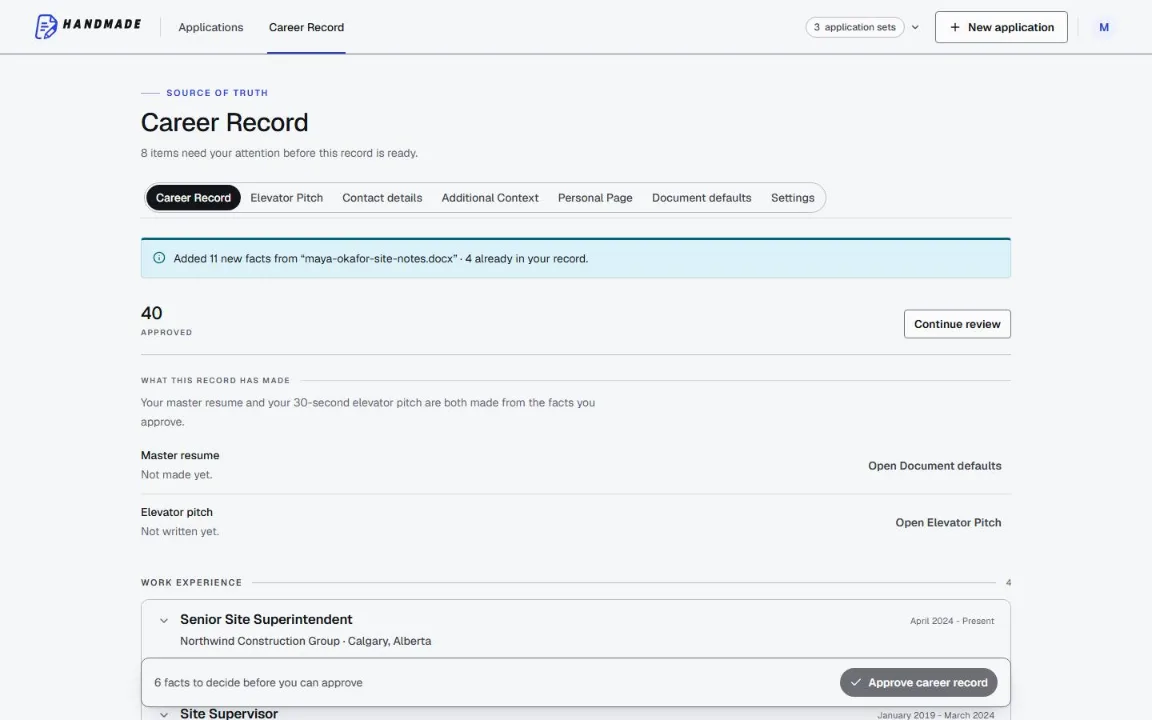
Keep your full work history in one Career Record, then tailor the top of your resume for the role you want. You can edit every line before downloading a format-checked PDF or DOCX.
2 complete application sets free, at the same quality as a paid plan. No card required.