One page or two? Deciding resume length
How to decide length on evidence density rather than folklore, and how to cut or fill honestly.
5 minute readPublished Updated
Short answer
Length follows how much relevant evidence you have, which usually means one page early on and two once you have several substantial roles behind you. A second page is not the risk; padding is, wherever it sits. Page one still has to carry the decision on its own, because page two is only reached after page one has worked.
Do this next
- Count the roles that genuinely bear on this posting, not the ones you have held.
- Put your summary, current role, and strongest evidence on the first page.
- Let earlier and unrelated roles compress to a line or two each.
- Cut whole items by relevance rather than shrinking the margins and the type.
- Either fill the second page properly or tighten back to one.
The rule that replaced the one-page rule
The one-page rule dates from paper stacks and is no longer treated as absolute. The convention that replaced it is proportionality: the resume is as long as its relevant, load-bearing evidence, and no longer. In practice that commonly means one page early in a career and two for an experienced professional.
What a reviewer tends to punish is not a second page; it is padding anywhere. A padded single page reads as thin. A tight second page reads as depth.
When one page is right
Students, recent graduates, and career changers whose relevant evidence is concentrated should stay on one page. Filling page two with coursework, high school, and hobby lists dilutes the material that matters.
One page is also the right discipline when applying far outside your experience level, where only a subset of your history is relevant.
When two pages are right
Several substantial roles, a long run of relevant experience, or a technical career with genuinely useful project and skills detail justify two pages. Cutting strong relevant accomplishments to satisfy a page count is the worse trade.
Page one must still carry the decision: summary, current role, and your strongest evidence all above the fold. Assume page two is read only after page one has already succeeded.
- Page onesummary, most relevant roles, strongest accomplishments.
- Page twoearlier roles, education, certifications, secondary skills.
- Never let a role's bullets straddle the page break awkwardly.
- Repeat your name at the top of page two and number both pages, because pages get separated.
- Older roles compress to one or two lines; they establish trajectory, not detail.
Resume Length Planner
Answer four questions and get a one-page, two-page, or CV starting point, plus what belongs on page one.
Substantial relevant roles
Project or publication density
Academic, scientific, or government application?
Cut by relevance, not by font size
Squeezing margins and dropping to nine-point type to fake a page count helps no one; it strains the reader and signals indecision. Cut content instead: whole bullets, then whole roles from decades past, by relevance to the specific posting.
Fixed, restrained typography keeps the decision honest, and we constrain ours on purpose. Our templates reflow the same way every time and hold type sizes readable, so a length decision stays a content decision.
Common questions
Will a two-page resume be rejected?
Is a 1.5-page resume acceptable?
Do these rules apply to academic or federal applications?
Use this in Handmade Resume
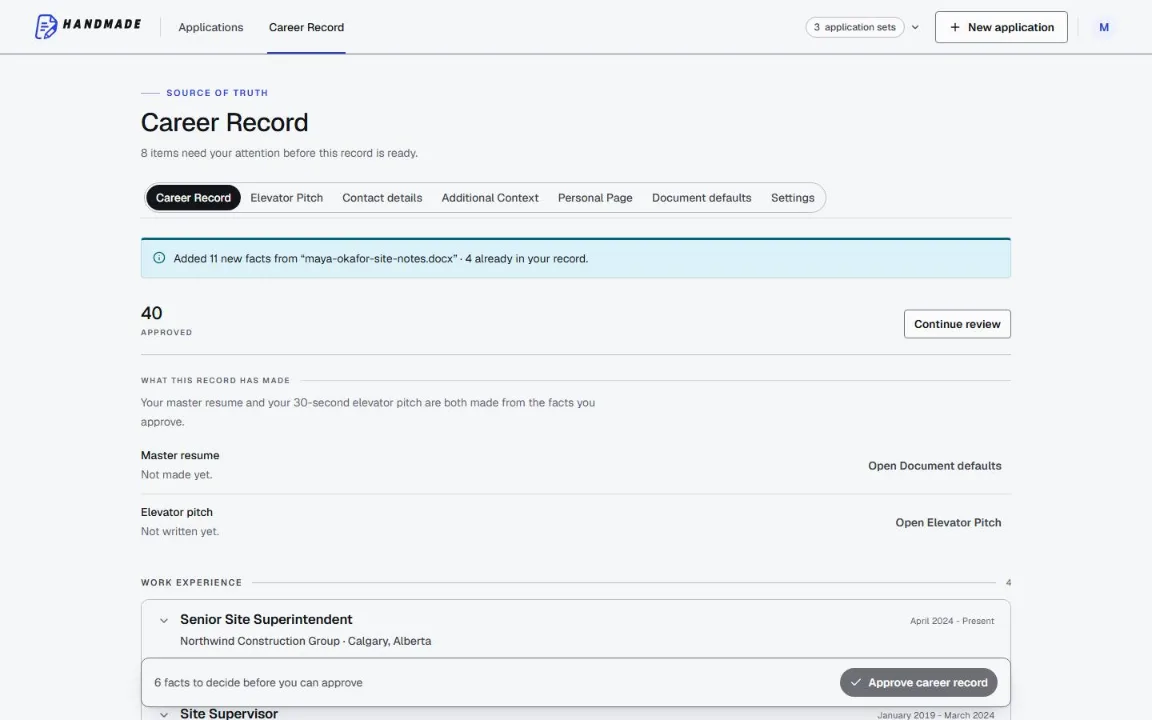

Keep your full work history in one Career Record, then tailor the top of your resume for the role you want. You can edit every line before downloading a format-checked PDF or DOCX.
2 complete application sets free, at the same quality as a paid plan. No card required.