Writing a resume with no work experience
Students and first-time applicants usually have evidence they were told does not count. Find it, place it, write it.
8 minute readPublished Updated
Short answer
You almost certainly have evidence somebody told you does not count: a class project with a real deliverable, a weekend job, a society role, unpaid work in a family business. Something belongs on the page once it produced a result another person relied on, assessed, paid for, or graded. Put education on top, write each item at the size it really was, and stay on one page.
Do this next
- List everything you have done that produced something outside your own head.
- For each one, write the brief, what you made, and who used or assessed it.
- Move education above your work history and put your capstone underneath it.
- Name each section for what is inside it, such as Academic Projects.
- Check every verb against your own part, and leave the numbers as they were.
The premise is usually wrong
Almost nobody who arrives at this page has nothing. What they have is evidence somebody told them does not count: a class project with a real deliverable, a capstone, a weekend job, a society treasurer role, three years of unpaid work in a family business, a period spent caring for a relative. Those are describable pieces of work with dates, constraints, and outcomes.
The advice feels impossible because it asks you to prove capability and then rules out most of the places you built it. Reverse the order. Start from everything you have actually done, decide honestly what each thing can and cannot claim, then write it at its real size. That is the same discipline a good resume needs at any career stage; it is simply more visible when your history is short.
What actually counts as evidence
Something belongs on your resume when it produced a result outside your own head that another person relied on, assessed, paid for, or graded. That is the whole test. It does not have to be paid, full time, or in your target industry.
An employer hiring at entry level is not expecting a work history they know does not exist. What they commonly look for is a situation in which you used a skill, rather than a list of skills you say you have. A list is a claim. A deliverable with a date and an audience is evidence, and it is also the thing an interviewer can ask a real question about.
- Coursework that produced a report, a program, a lab analysis, a design, or a dataset.
- A capstone or thesismonths of scoped work with a method and a supervisor.
- Volunteering with a recurring commitment to a named organization.
- Part-time, seasonal, or shift work, including the responsibilities you held alone.
- A side project somebody other than you can open and use.
- A competition or hackathon entry, described at its true placing.
- Work in a family business, described plainly as what it was.
- A caring responsibility, as a dated line that keeps your timeline accurate.
- Military service, translated out of service vocabulary into ordinary nouns.
- An elected or appointed role in a student society, at its real scale.
Evidence Finder
Tick what applies to you. Get what each one legitimately becomes on the page, what it cannot claim, and a wording pattern to fill in.
Which of these apply to you?
What changes structurally
With no formal work history, three things move. Education goes above experience, because it is your most recent and most relevant block; it drops back below experience once you have real roles to show. The section that would be Experience often splits into Projects, Experience, and Volunteering, because your evidence genuinely lives in more than one place.
Stay on one page. A second page padded with high school, hobbies, and a list of module titles reads thinner than one page of real material. Give each entry only the bullets it has real material for, and give your strongest entry the most of them, wherever it sits on the page.
Name sections for what is inside them. An Academic Projects heading is legitimate, commonly used, and tells a reader exactly what they are looking at. A Relevant Experience heading followed by nothing that resembles a job does the opposite, because the reader spends the start of their read working out that they have been misled.
Turning one project into three bullets
The hardest part is not finding the material, it is writing it at the right size. Take one thing you did and answer three questions about it in order: what was the brief, what did you actually produce, and who used or assessed the result. That is three bullets, and it is more than many entry-level resumes manage from a whole page.
Worked through on an invented class project: the weak version is 'completed a group data analysis project.' The strong version names the dataset, the method, the deliverable, and the audience, and it does it without inventing a number. Nothing in the strong version claims more than the weak one; it just says what actually happened.
- Brief'Six-week team project forecasting regional bus demand from three years of open transit data.'
- Produced'Built the cleaning pipeline and the seasonal model in Python; wrote the twelve-page method report.'
- Audience'Presented to the module convenor and two transit planners who use the open data professionally.'
- Keep the scale honestsay the team was four people, and say which part was yours.
- Name the tools by their real names, and only the ones you used yourself.
- If the work is still visible somewhere, add the link. A reader who can open it stops needing to trust you.
The objective statement trap
The old convention was to open with an objective: seeking an entry-level position where I can use my skills and grow with a forward-thinking organization. It states what you want. The reader is screening for what they need, and every applicant wants the job, so the line carries no information while occupying the most valuable space on the page.
Replace it with two or three lines of evidence, or with nothing at all. Name what you are, then your single strongest item, then the specific thing in the posting your history answers: 'Statistics graduate. Capstone forecasting regional bus demand from three years of open transit data. Two years of weekend retail work alongside full-time study.' Every clause there is checkable, and none of it could be copied by another applicant.
If you cannot yet write three checkable lines, leave the summary out and let education lead. Empty space above your strongest entry costs you less than a sentence that would fit anyone.
Write it without inflating it
The pressure to embellish is highest exactly here, and it is the quickest way to lose an interview you would otherwise have had. Inflation is rarely a lie about a whole job. It is a verb creeping upward, a committee of five becoming a team of forty, a class exercise becoming a client project, a script nobody runs becoming a launched product.
The honest version usually persuades better, because it survives the follow-up question. State the scale plainly, name the audience, and keep the words describing your own part exact.
- 'Led' means you were accountable for the outcome. 'Coordinated', 'built', and 'helped run' are specific and respectable.
- A committee of five is not a membership of forty. Say which number you mean.
- A course project is a course project. Naming the brief makes it stronger, not smaller.
- Claim a placing only if you placed. Entering a competition is still worth a line.
- Give a number only when you counted it, and say what period it covers.
- Do not give family business work a job title nobody there ever used.
Freshers and new graduates applying at volume
In Indian recruitment the usual word for this position is fresher, and that market commonly runs at a scale which changes the tactics: large intakes, campus rounds, portals, and postings whose requirement lists often read as copied from an older posting and lightly edited. Treat a requirement list as a description of the ideal candidate rather than a gate, and apply when your evidence covers the core of it.
Volume also means one document goes out many times, so it is worth building once and building it properly. Keep a single record of everything you have done, with real dates and honest wording, and draw every application from that record. Our builder works this way on purpose: one approved set of your facts, with every tailored version checked against it, so scaling up your applications does not quietly scale up your exaggerations.
Common questions
Do class projects really belong on a resume?
Where does education go?
Should I include my GPA?
What do I actually put on a resume with no work experience?
Is unpaid or family work allowed?
Use this in Handmade Resume
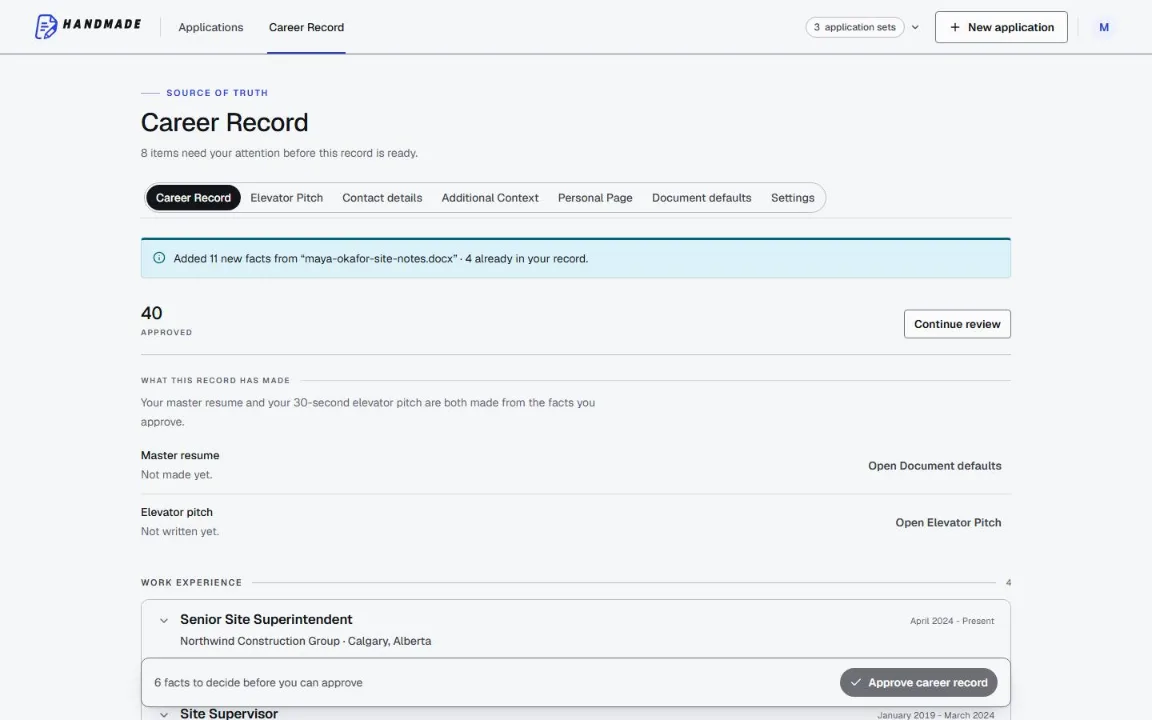
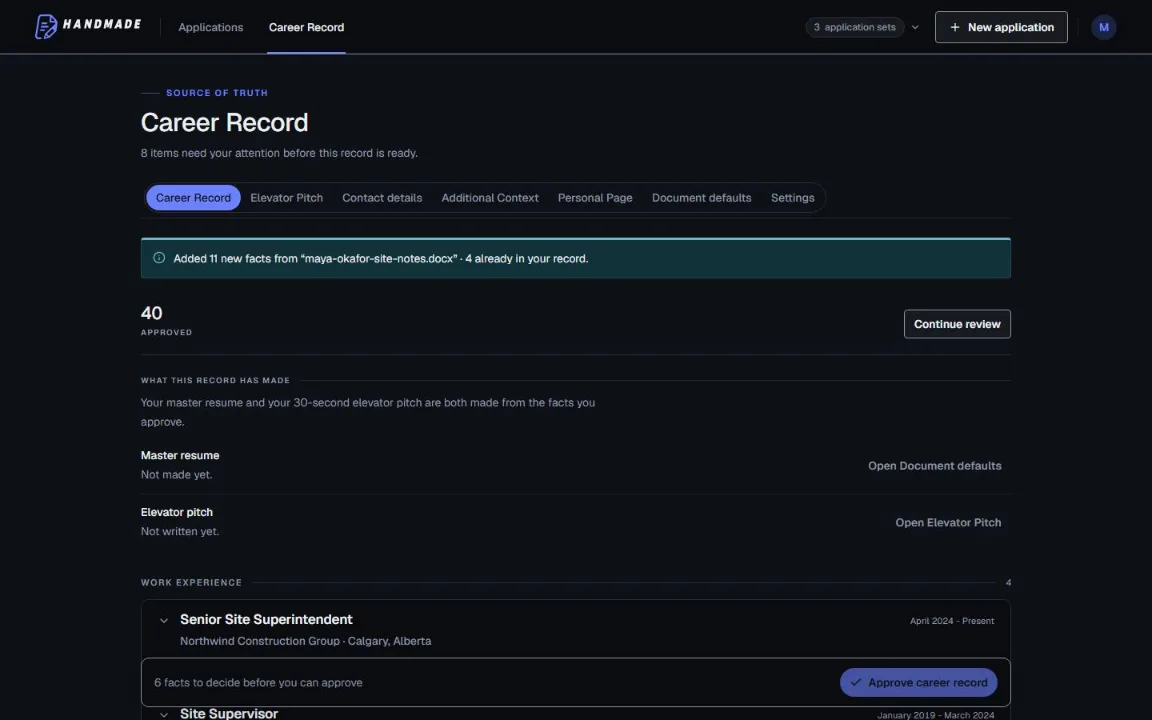
Keep your full work history in one Career Record, then tailor the top of your resume for the role you want. You can edit every line before downloading a format-checked PDF or DOCX.
2 complete application sets free, at the same quality as a paid plan. No card required.