Resume examples, annotated: what changed and why
Weak-to-strong bullet rewrites for five common situations, plus two complete sample documents, labelled as illustrations and explained line by line.
9 minute readPublished Updated
Short answer
Read an example for the move it makes, never for the wording, because the wording belongs to somebody whose work was not yours. Almost every strong rewrite is one of three changes: a duty turned into an outcome, a paragraph split into one claim per line, or ornament reduced to a single reading column. Copy the arrangement and refill it with your own material.
Do this next
- Find one line of your own that reads like a job description and mark it.
- Rewrite it as what happened because you were there, result first.
- Add the scale you can defend and the period it covers.
- Say who used, bought, graded, or relied on what you produced.
- Read it aloud and rewrite it again if the obvious question worries you.
How to use an example
An example earns its space only if you can see what changed. A finished bullet you admire teaches you nothing you can apply, because your facts are not that person's facts. The move that produced it applies to any facts at all. Read every pair on this page for the move, not for the wording.
That also means you should not lift a line. A borrowed bullet describes work you did not do, and it will not survive the question that follows it in an interview. Take the structure, then refill it with your own material.
Three moves that do most of the work
Nearly every strong rewrite is one of three changes, and they hold across industries and seniority levels. Learn the three and you can rewrite your own page without a single example in front of you.
Only the third is a formatting rule. The other two change what your sentences contain, and that is where most of the available improvement sits.
- Duty to outcomereplace what you were responsible for with what happened because you did it.
- Paragraph to bulletssplit a block of prose into one claim per line, each opening with a precise verb.
- Ornament to structuredrop columns, sidebars, icons, and graphics. A single reading column is easier for a person to skim, and a columned layout is a common reason a file fails to extract into text, because the parser has to work out the reading order before it can read a word.
Rewrites by situation
The five situations in the viewer below are the ones where people get stuck, because each creates a specific problem on the page: a history written in the wrong industry's vocabulary, a hole in the dates, an absence of jobs, two titles at one employer, or a duty list identical to every other applicant's.
Each pair shows the weak version, the stronger version, what structurally changed, and why the change works on a reader. The reasoning is the part worth keeping. Switch situations even if only one is yours, because the moves transfer.
Annotated Sample Viewer
Weak-to-strong rewrites for five situations, plus two complete sample documents in real templates. Every pair says what changed and why.
What do you want to look at?
Your history is real and it is in the wrong vocabulary. The reader has to translate it, and readers under time pressure do not translate.
Before
Responsible for the daily operations of a busy restaurant section.
After
Ran nightly service for a 40-cover room, including the till, the close-down cash count, and the handover notes the morning shift worked from.
What changed
Names the systems and the artifact instead of the job-description phrase.
Why that is stronger
Nobody outside hospitality can picture daily operations. A till, a cash count, and a written handover are nouns an operations manager already uses, so the translation happens for them rather than by them.
Before
Excellent transferable skills, looking to move into project coordination.
After
Built the weekly rota for nine staff and covered holiday and short-notice absence.
What changed
Replaces a claim about yourself with the work that would support it.
Why that is stronger
Transferable skills is a request for the reader to do your argument. Rota, holiday, and absence cover are the actual content of coordination work, and they are checkable in a way an adjective is not.
Before
Keen to apply my hospitality background to a data role.
After
Completed a part-time data analysis certificate in 2025 while working full time, and rebuilt the weekly stock forecast the kitchen now orders against.
What changed
Puts evidence on both sides of the change: new training, and the old job used differently.
Why that is stronger
A career change is credible when something already connects the two halves. The forecast is the connection, and it is dated, small, and true, which reads better than a large statement of intent.
Showing 3 rewrites for career change. The reasoning is the part to keep, not the wording.
You can see the move, not just the finished line.
Write your own version in Handmade Resume, where every line has to trace back to a fact you approved.
Two complete samples, and what they are not
The viewer also holds two full documents, rendered with the same style tokens our templates use. They exist to show shape: what leads the page, how much room each entry gets, where education sits, and how a summary reads when every clause in it is checkable.
Both are illustrative composites. Neither is a real person, neither is a customer, and neither was ever sent to an employer. The names are placeholders and the employers are labelled as placeholders on purpose. A sample dressed up as somebody's real success story is a fabricated reference. Every worked example on this site is invented for illustration, and none of them is a real person's resume.
Use them the way you would use a floor plan. Copy the arrangement, not the furniture.
Where examples mislead
Published examples often carry invented numbers, because a specific figure looks stronger than a vague one and a sample is rarely checked. Copying that habit is how a resume acquires a metric its owner cannot explain. If you did not count it, do not print it. Specificity about systems, artifacts, and audiences does the same job and costs you nothing in the interview.
The second failure is sameness. Examples get copied, and AI drafts trained on the same examples tend to reproduce the same handful of openings, so a bullet that begins with 'spearheaded' and ends with 'driving impactful results' now reads as a template rather than a person. Distinctiveness comes from detail only you could have supplied.
The third is decoration. Heavily designed samples with two columns, a skills sidebar, and a photograph look impressive in a gallery and read badly on the day. They also give the parser more chances to reorder your text. A plain single column is the safer thing to copy.
Turning an example into your own line
Work backwards from the pair. Find the piece of your own work that has the same shape as the weak version, then fill in the parts only you know. Five checks catch most of what goes wrong.
- Name the thing you produced, not the area you worked in.
- Add the scale you can defend, and the period it covers.
- Say who used, bought, graded, or relied on the result.
- Choose the verb that matches your actual part: built, coordinated, supported, led.
- Read it aloud and ask what the follow-up question would be. If you would rather not be asked, rewrite it.
Common questions
Can I copy a bullet from an example?
Are the sample resumes on this page real?
Should I copy the layout of a designed example?
What should a good resume example show me?
What if I have no numbers to put in?
Use this in Handmade Resume
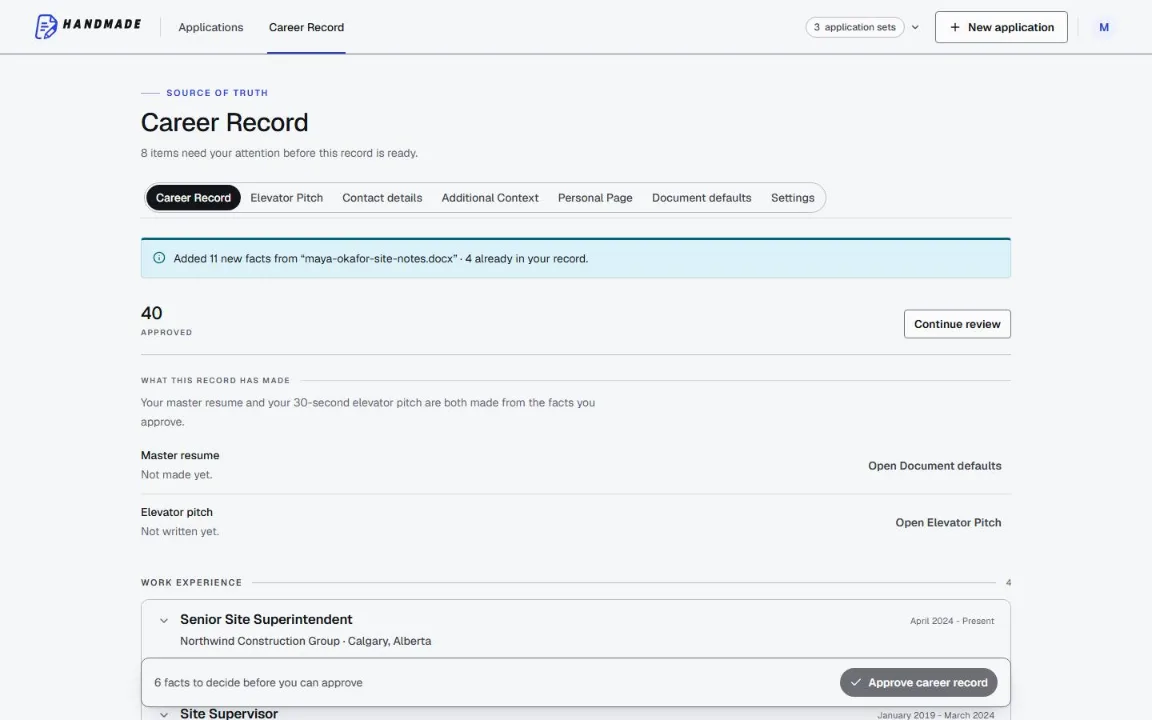
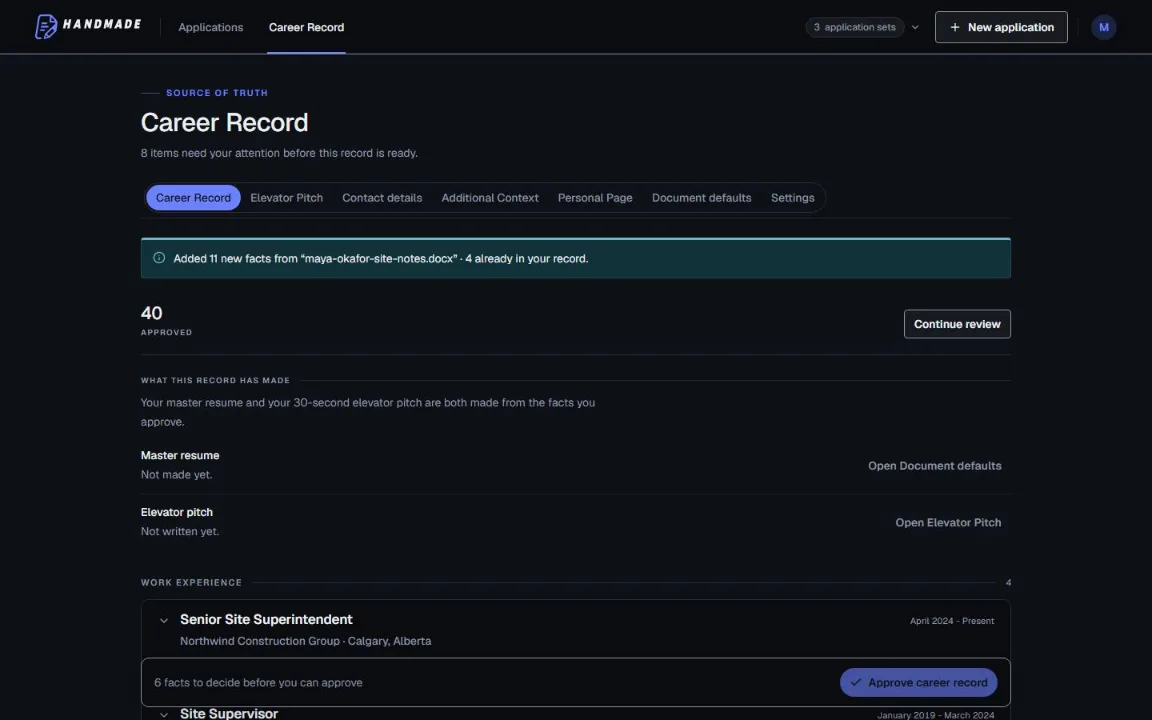
Keep your full work history in one Career Record, then tailor the top of your resume for the role you want. You can edit every line before downloading a format-checked PDF or DOCX.
2 complete application sets free, at the same quality as a paid plan. No card required.