Writing a resume summary that is not generic
Replacing the interchangeable 'results-driven professional' paragraph with three lines of evidence that fit one specific job.
5 minute readPublished Updated
Short answer
Cover your name and read the paragraph back: if a hundred other applicants could publish it truthfully, delete it. A summary that earns its place says what you are with a number and a domain, gives one real accomplishment, and names the thing in this posting your history answers. If you cannot fill those three lines from facts, give the space to your first role.
Do this next
- Write what you are in one clause, with years and the field you work in.
- Add the single accomplishment that best answers this particular posting.
- Name the requirement your history answers, in the employer's own phrasing.
- Strike every adjective and check that what remains can be traced to a fact.
The test for a summary
Cover the name on your resume and read the summary. Could a hundred other applicants publish the same sentence truthfully? 'Results-driven professional with excellent communication skills and a passion for innovation' passes for anyone, which is exactly why it works for no one.
A summary earns its space when it could only be about you, and reads like it was written for this posting. Otherwise the space belongs to your first role.
A three-line structure
Line one: what you are, concretely, with years and domain. 'Payroll accountant with six years in multi-entity payroll.' Line two: your strongest evidence for this posting, one real accomplishment. Line three: the specific match, the thing in their posting your history answers.
Every phrase should be checkable. Adjectives ('dynamic,' 'passionate,' 'detail-oriented') assert what evidence should demonstrate; if a claim in your summary cannot be traced to a fact in your record, it is decoration, and decoration is what makes summaries generic.
Summary Specificity Builder
Shape three lines from your own words and flag the interchangeable cliches. Nothing is invented. Every line uses only what you type.
What you actually do (e.g. “Payroll administrator”), not a slogan.
Only include this if you can confirm it below. Otherwise it is left out.
One true thing you can stand behind. Use your own numbers and outcomes. We won't add any.
Paste the single requirement this summary should speak to. Adding one switches the follow-up to tailoring.
Cliches and their replacements
Most summary cliches are compression artifacts: a real, specific fact was flattened into a stock phrase. The fix is decompression, back to the fact.
- 'Results-driven'name the result. 'Reduced month-end close from ten days to six.'
- 'Excellent communicator'name the artifact. 'Wrote the client onboarding documentation used across three teams.'
- 'Team player'name the collaboration. 'Worked daily with engineering and finance on billing accuracy.'
- 'Proven track record'the record is the resume below; point at its strongest line instead.
Tailor it per application
The summary is the most tailoring-sensitive text on the page: it is the first thing read against the posting. When we generate a resume, the summary is composed against the specific job description from your approved facts, and checked back against your record like every other sentence. Done by hand, rewrite line three, at minimum, for every application.
Common questions
Do I need a summary at all?
Source: How to write a CV, National Careers Service (UK government)
Summary or objective?
How long should it be?
Use this in Handmade Resume
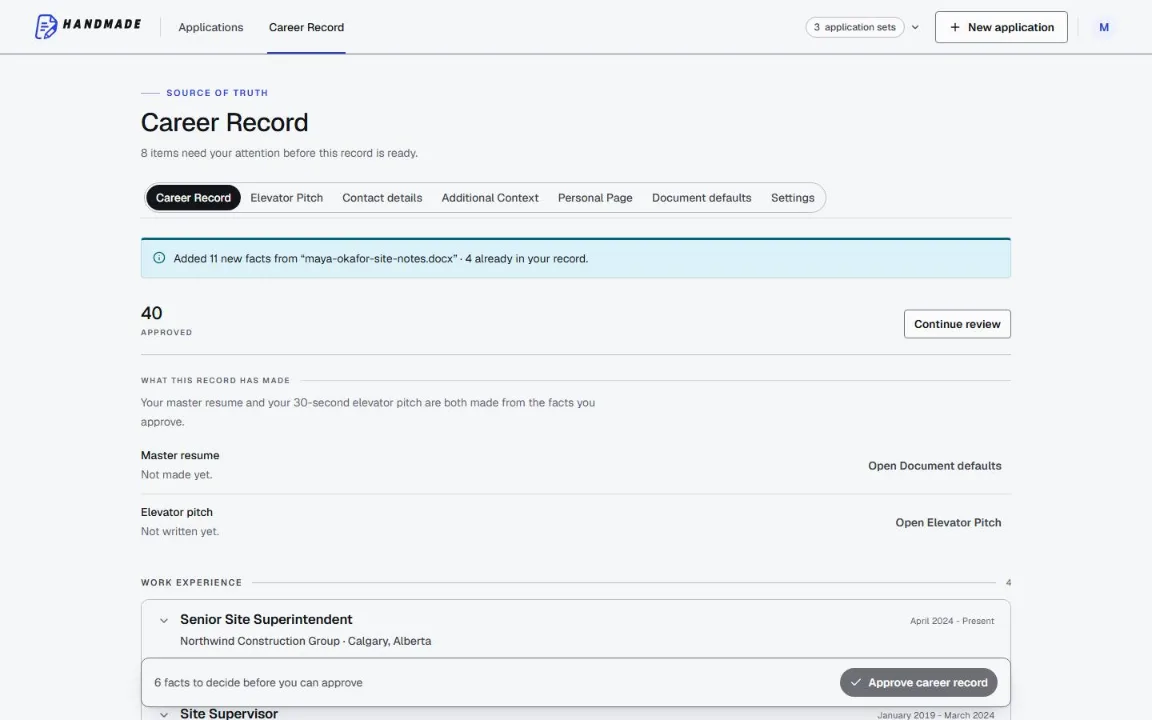
Keep your full work history in one Career Record, then tailor the top of your resume for the role you want. You can edit every line before downloading a format-checked PDF or DOCX.
2 complete application sets free, at the same quality as a paid plan. No card required.