How to explain employment gaps without lying
Handling gaps honestly: what to state, what to leave out, and why moving dates reliably backfires.
6 minute readPublished Updated
Short answer
Put your real dates on the page and leave a break of a few months unmentioned. For a longer one, a single neutral line is enough, on the resume or in the letter, and the personal detail behind it is yours to keep. Stretching dates is the move that reliably goes wrong, because dates are the easiest thing on a resume for an employer to check.
Do this next
- Write the true start and end month for every role before you format anything.
- Leave a break of a few months alone; it commonly passes without comment.
- Give a longer break one plain line naming what it was, then stop explaining.
- Record anything professional you did during it at the size it actually was.
- Rehearse a calm spoken version, so the question is answered rather than survived.
Gaps are information, not disqualification
Careers include gaps: layoffs, caregiving, illness, immigration timelines, education, burnout recovery, a business that did not work out. Hiring managers see them often, and since 2020 a break has become an ordinary thing to find on a resume. What raises flags is not the gap; it is the appearance of concealment.
Your obligation is accuracy, not disclosure. You must not misstate dates or invent activity. You are not required to explain personal circumstances in any detail.
The one thing never to do
Do not stretch employment dates to paper over a gap. Dates are the easiest claim on a resume to verify: an employer can confirm them with your previous employers or through a background-check service, and employers may treat a date discrepancy discovered after an offer as a reason to withdraw it, or as misconduct if it surfaces after hiring.
Using years without months ('2021 - 2023') is common formatting, but an application form or a background check may ask for the months later. Formatting can soften the visual; it cannot substitute for an answer you are prepared to give.
How to present a gap
For short gaps (a few months), say nothing on the resume; in English-speaking markets they commonly pass without comment. German practice runs the other way: a break in the dated timeline longer than about two months gets its own line, so check the destination before you leave a gap silent; our German CV guide has the detail. For longer gaps, one plain line is enough, either as a resume entry or a cover letter sentence: 'Career break for family caregiving, 2022 - 2023.' No apology, no detail beyond what you choose.
If the gap contained anything professionally relevant (coursework, certification, freelance projects, volunteer work), list it as what it was, at the scale it was. A six-week course is a line, not a job entry.
- State real dates everywhere, always.
- One neutral line for long gaps; silence for short ones.
- List genuine gap activity truthfully and proportionately.
- Prepare a two-sentence spoken answer, delivered without apology.
Source: Den perfekten Lebenslauf erstellen, Bundesagentur für Arbeit
Gap Wording Planner
Choose a few broad options and get neutral, ready-to-adapt ways to present an employment gap, keeping every real date exactly as it happened.
How long is the gap?
Do you want to disclose a reason?
Where the emphasis belongs
The strongest response to a gap is a resume whose evidence makes it uninteresting. Lead with your strongest relevant accomplishments, tailor tightly to the posting, and let the gap be a footnote in a compelling document rather than the headline of a thin one.
Common questions
Do I have to explain a mental health or medical gap?
Should I use a functional (skills-based) resume to hide gaps?
How do recruiters actually verify dates?
Use this in Handmade Resume
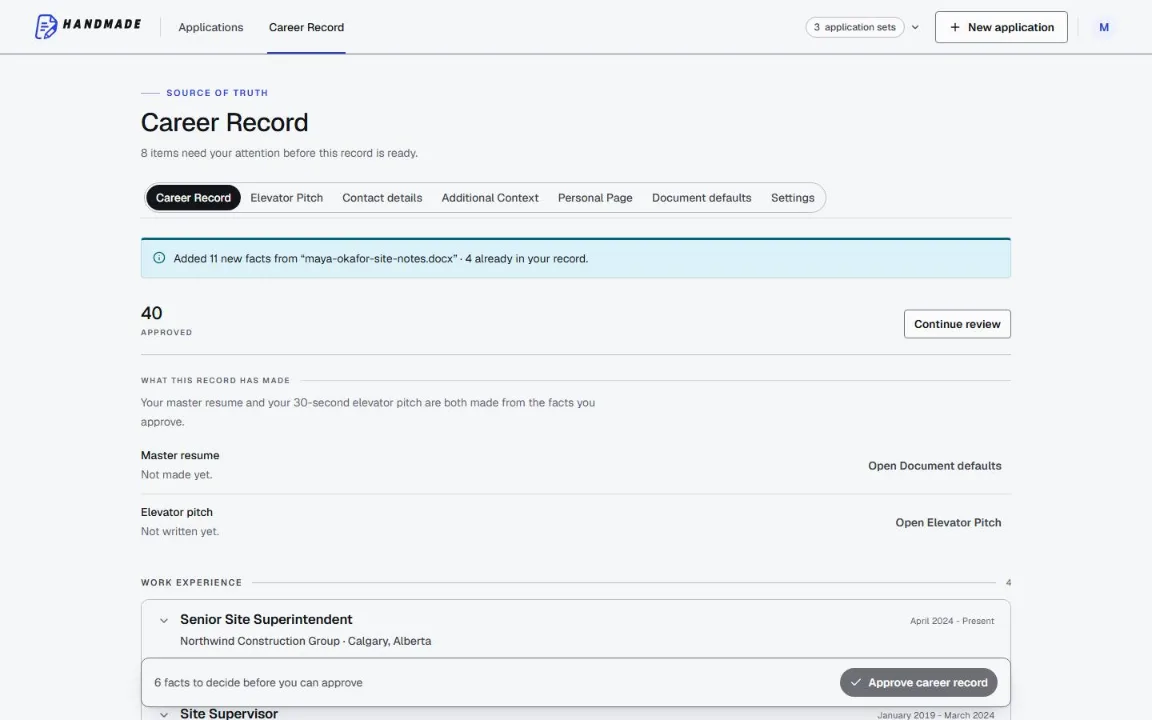
Keep your full work history in one Career Record, then tailor the top of your resume for the role you want. You can edit every line before downloading a format-checked PDF or DOCX.
2 complete application sets free, at the same quality as a paid plan. No card required.