How to write a German CV (Lebenslauf)
What a German application package contains, the real rule on the photo, and how signatures and certificates work.
9 minute readPublished Updated
Short answer
A German employer conventionally expects a package rather than one file: cover letter, then the tabular Lebenslauf, then the photograph, then certificates and employer references. The Lebenslauf itself runs one to at most two A4 pages of dated rows, newest first, and it conventionally carries your date and place of birth, which British and North American advice trains you to strip out. A break of more than two months gets its own dated line instead of being left silent.
Source: Den perfekten Lebenslauf erstellen, Bundesagentur für Arbeit
Do this next
- Rebuild the CV as dated rows of period and content, most recent first.
- Put your date of birth and place of birth back into the details block.
- Give every break longer than two months its own dated line.
- Add the city, today's date and your signature at the foot of the page.
- Assemble the package in order, merged into one PDF for an email application.
What a German employer expects to receive
A German application is conventionally a set of documents assembled in a customary order: the cover letter first, then the tabular CV, then the photograph, then your certificates and employer references. That is the widest gap between applying here and applying in Britain or North America. Sending a bare CV where a package is expected is a common mistake for foreign applicants, and it reads as an incomplete application rather than a concise one.
For an email application, the usual practice is to convert each part to PDF and merge the whole set into one combined file, in that order. For a portal, upload the parts separately into the fields it provides and do not merge them, because a portal that asks for four uploads is going to route them to four places.
Two optional components are worth knowing about so you can recognise them rather than feel obliged to produce them: a Deckblatt, a cover sheet carrying your name, the role and your photograph, and a Motivationsschreiben, a longer motivation letter sometimes called the third page. Neither is required by convention, and neither is commonly expected for an entry-level application.
The photo: customary, not required, and what an employer may ask of you
A photograph on a German CV is no longer a must and is still usual in many industries. That one sentence settles both overreaches you will read elsewhere. It is not compulsory, so leaving it off is within convention, and it is not forbidden either, so a page telling you a photo is illegal in Germany or banned by data protection law has overstated the law.
State the law precisely, because the confusion around it is expensive. German anti-discrimination law names the grounds an employer may not decide on: race or ethnic origin, sex, religion or belief, disability, age, and sexual identity. Nothing in that list requires a photograph or bans one. What the law does is put the employer at risk, because a photograph can evidence a protected characteristic and an employer who has seen one may have a harder time showing a decision was unrelated to it. That risk sits on their side of the table, not yours. The same law reaches the advert itself: a job may not be advertised in a way that discriminates on those grounds, so a posting that asks for a young applicant is a warning sign about the employer rather than a rule you have to meet. Data protection law is generally about a different thing again, how long an employer may keep your application and when it must be deleted.
If you include one, the quality expectation is real. A studio portrait is the convention; a phone selfie and a plain passport photo commonly read as not having tried. Placement is settled by convention: on the Deckblatt if you use one, otherwise at the top of the Lebenslauf. If you would rather not include one, the honest position is that you are within convention and that some traditional employers may notice.
Germany, Austria and Switzerland are three markets, not one. This page describes German practice. Do not assume the Austrian or Swiss expectation on photographs and cover letters is the same, because it may not be, and treating the three as a single convention is a common mistake.
Sources: Den perfekten Lebenslauf erstellen, Bundesagentur für Arbeit; § 1 AGG, Ziel des Gesetzes, Bundesministerium der Justiz (gesetze-im-internet.de); § 11 AGG, Ausschreibung, Bundesministerium der Justiz (gesetze-im-internet.de)
Personal details a German CV includes that others leave out
This is where Germany runs opposite to the markets most English-language advice is written for. A Lebenslauf conventionally carries your date of birth and your place of birth, listed as ordinary contents rather than as an unusual disclosure. British practice leaves date of birth off the page, and North American practice omits it as a matter of course, so an applicant arriving from either will have been trained to strip out exactly what a German reader commonly expects to see.
Several other details are genuinely optional. By convention, family details and nationality are voluntary. Religion conventionally goes on the page only if the employer asks for it. Details of your parents' occupations used to be usual and are no longer expected, so a template that asks for them is an old template. A disability conventionally belongs on the page only where it affects the work you would be doing.
- Conventionally expectedfull name, address, telephone number, email address, date of birth, place of birth.
- Voluntarymarital and family status, nationality.
- Only if askedreligion.
- Only if it affects the worka disability.
- No longer expectedyour parents' occupations.
- Nevera tax identification number, a social security number, or bank details.
Form, length, and the gap rule
The document is a tabellarischer Lebenslauf, a tabular CV: dated entries in a clean two-column table of period and content, not a prose narrative. One to at most two A4 pages is the norm, and reverse chronological order is standard, beginning with the most recent entry. The older forward-chronological form that started at primary school is a historical curiosity now and reads as out of date.
The rule with no British or North American equivalent is the gap rule: a German reader expects the dated timeline to be continuous, so a break of more than two months, which another market would pass over without comment, is expected to carry its own line here. Parental leave, a period of unemployment, illness, a sabbatical or a long job search all get a dated entry rather than being left as silence in the timeline. This runs against the instinct a foreign applicant usually arrives with, which is to make gaps invisible, and in Germany an unexplained gap commonly becomes the first question rather than a fact nobody noticed.
The formatting expectations are conservative and easy to meet: single column, one legible typeface, real headings, consistent date formatting, and a plain reverse-chronological order for both work and education. A designed two-column layout with sidebars and icons is a worse document here for the same reason it is a worse document anywhere, and it also breaks the tabular convention the reader is scanning for.
Source: Den perfekten Lebenslauf erstellen, Bundesagentur für Arbeit
Place, date and signature
Signing a Lebenslauf is conventional and not strictly necessary, whatever flat rule you read elsewhere. The reason to do it is specific. A place, the current date and a signature at the foot show that this version is current and that you stand behind what it says. That is a cheap piece of credibility, and it costs one line.
Practically, put the city and the date on one line at the bottom, with your signature underneath. For a digital application, a scanned or drawn signature image is the usual practice, and a certificate-backed digital signature is not expected. Do not let anyone tell you a German CV must be signed, because it need not be; do let the convention nudge you into doing it, because the date is the part that carries the value.
Source: Den perfekten Lebenslauf erstellen, Bundesagentur für Arbeit
The Anschreiben, the Zeugnisse, and the Arbeitszeugnis
The Anschreiben, the cover letter, remains in practice the standard first component of a German application and is conventionally written for the specific role rather than adapted from a stock paragraph. Where an online form marks the cover letter field optional, take that at face value, because employers who have made it optional have generally done so deliberately. Where nothing is said, include one.
Zeugnisse are attachments, and this is the part with no equivalent elsewhere. Degree and school certificates conventionally travel with the application, and sending your last two school certificates is a common custom. So do employer references, which brings up the institution that makes this market genuinely different: the Arbeitszeugnis, a written reference an employer conventionally provides when you leave, and one you can ask for. It is expected to be both truthful and benevolently worded, and those two expectations together have produced a coded vocabulary in which mild-sounding praise can read to a German recruiter as a poor grade. Read yours carefully before attaching it, and ask for a correction if the wording undersells you. It is normal to ask.
What our builder does here is the Lebenslauf component, in English: a single-column, reverse-chronological document generated from facts you approved rather than reconstructed from memory, with dated entries newest first, exported as a text-based PDF whose extracted text we check before you download it. The gap lines, the German wording, the photograph, the Deckblatt and the scanned certificates are yours to supply, and the package is yours to assemble in the order above.
Common questions
Is a photo required on a German CV?
Source: Den perfekten Lebenslauf erstellen, Bundesagentur für Arbeit
Do I have to put my date of birth on a Lebenslauf?
Does a Lebenslauf have to be signed?
Source: Den perfekten Lebenslauf erstellen, Bundesagentur für Arbeit
How long should a Lebenslauf be?
Source: Den perfekten Lebenslauf erstellen, Bundesagentur für Arbeit
Do I still need to write an Anschreiben?
Use this in Handmade Resume
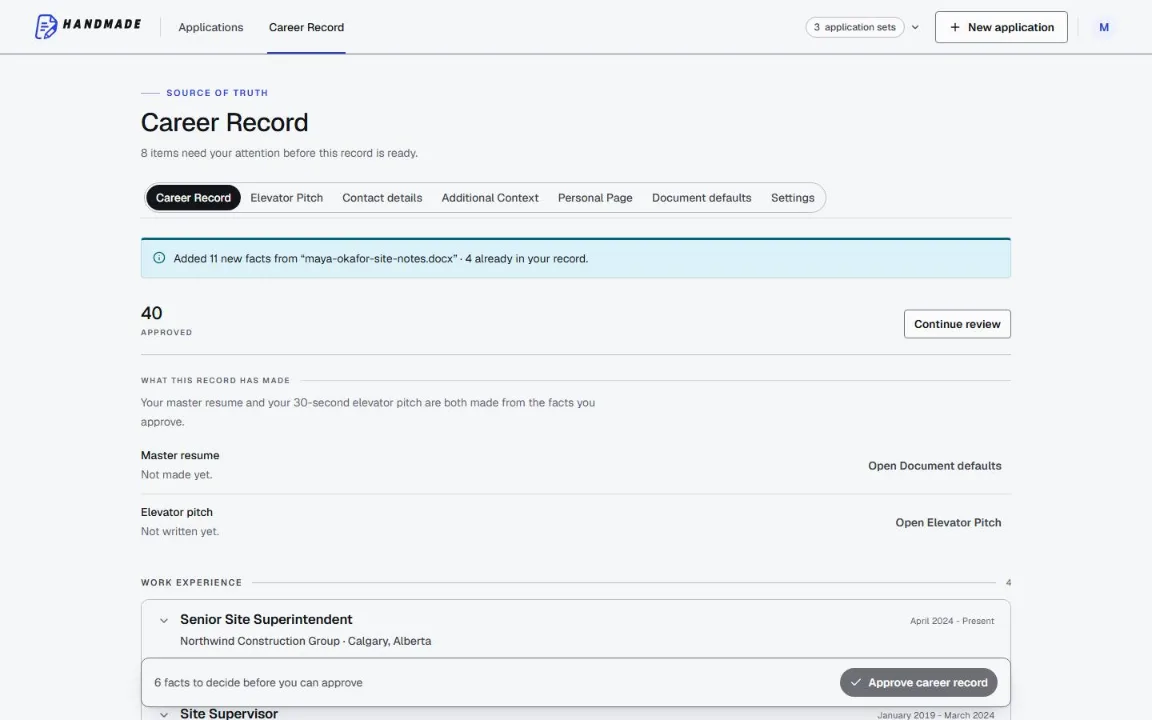
Keep your full work history in one Career Record, then tailor the top of your resume for the role you want. You can edit every line before downloading a format-checked PDF or DOCX.
What you get, exactly: We produce the Lebenslauf component only: a single-column, reverse-chronological, English-language document on Letter-size pages (the DOCX is editable if you need A4) with real selectable text. We do not write it in German, place the photograph, build a Deckblatt, or assemble the certificates and employer references that complete a German package.
2 complete application sets free, at the same quality as a paid plan. No card required.