Resume format by country: what actually changes
Photos, date of birth, references and length follow opposite rules by market. What to change before you send.
9 minute readPublished Updated
Short answer
The argument your document makes travels unchanged: relevant evidence, newest first, aimed at one posting. What moves between markets is the personal details block at the top, the photograph, the word printed on the advert, the length, and whether references belong on the page at all. Settle the destination first and rebuild that top block for it, because a downloaded template arrives with somebody else's market wired into it.
Do this next
- Confirm which country the hiring team sits in before you change anything.
- Rebuild the personal details block for that destination, field by field.
- Settle the photograph on the destination rather than on your template.
- Reread the advert: a stated page limit or supplied form beats any convention.
- Take every government identity number off the page, whichever market it is.
Which parts of a resume change between countries?
Fewer parts than a template suggests, and more than a North American guide admits. The argument the document makes does not change anywhere: relevant evidence, newest first, aimed at one posting. What changes is the personal details block at the top, the photograph, the word printed on the advert, the length, whether references belong on the page, and which of those an employer is legally barred from asking you about.
Treat the United States and Canada as one baseline rather than two markets. Their conventions do not meaningfully differ in practice, and the split most often repeated, that Canadian resumes run two pages while American ones run one, describes a difference in habit rather than a rule: the same length argument runs inside both. The baseline is no photograph, no date of birth, no marital status, no nationality, no government identity number, references kept off the page, single column, reverse chronological, one to two pages. In the United States that baseline has an employer-side basis: pre-employment information is meant to be limited to what is essential for deciding whether you are qualified, and a photograph is something an employer may obtain after an offer is made and accepted, not before.
Everything below is a departure from that baseline. Where a market is not covered here, assume the baseline and take the personal details from the destination rather than from a downloaded file. The personal details block is the part of your document you rebuild per destination, and it is the part a foreign template gets wrong most often, because it ships with fields somebody else's market expects.
Source: Prohibited Employment Policies/Practices, U.S. Equal Employment Opportunity Commission
Date of birth: three opposite conventions
One field, three opposite positions, and no way to satisfy all of them at once. In Germany, date of birth and place of birth are conventionally listed on a Lebenslauf, and a German reader is used to seeing them there. In the United Kingdom, date of birth is left off, alongside age, marital status and nationality. In the United States the rule points at the employer instead: pre-employment questions that would indicate age are meant to be avoided, so the question itself is discouraged rather than only the decision behind it.
Generic international resume advice cannot survive that one field. Almost every page answering the question picks one market's convention and prints it as a universal rule, and a reader who follows it into the wrong country either looks out of touch or omits something the reader there expects to see.
The practical version is short. Decide the destination first, then build the personal details block for that destination, and never let a template decide it for you. A frame for a photograph and a slot for a birth date are not neutral defaults; they are one market's expectations wired into a file.
Sources: How to write a CV, National Careers Service (UK government); Prohibited Employment Policies/Practices, U.S. Equal Employment Opportunity Commission
The photo question is not one question
Ask it as three separate questions and it becomes answerable: is a photograph expected here, is it permitted, and what does this market think a good one looks like. Many guides collapse all three into a single yes or no and then get the details wrong in both directions, describing a photo as mandatory where it is optional and as illegal where it is merely customary.
In Germany a photograph is customary and no longer a must. It remains common, and German anti-discrimination law names the grounds an employer may not decide on rather than saying anything about photographs, so a photo is a convention that sits outside the law rather than something it requires or bans. The expectation about quality is real, though: a studio portrait is the convention, and a phone selfie or a plain passport photo commonly read as not having tried. In the United Kingdom, the United States, Canada and Indian private-sector hiring, the convention is no, and in North America it can count against you: a US employer may obtain a photograph after an offer is made and accepted, and is expected to avoid pre-employment information that points at what it must not decide on.
The sharpest case is the Philippines, because the answer depends on which document you are being asked for. A private-sector resume treats a photograph as optional and role dependent, more common in customer-facing work and often dropped after a first job. Civil service employment uses a prescribed government form, the Personal Data Sheet, and its instructions call for a photograph at a set size: passport size, 4.5 cm by 3.5 cm, taken within the last six months, with your name tag and signature. The claim that circulates, that Filipino applications need a 2 by 2 photograph, describes a general identity-photo size rather than what the form's instructions call for.
Sources: Den perfekten Lebenslauf erstellen, Bundesagentur für Arbeit; § 1 AGG, Ziel des Gesetzes, Bundesministerium der Justiz (gesetze-im-internet.de); Prohibited Employment Policies/Practices, U.S. Equal Employment Opportunity Commission; CS Form No. 212, Revised 2017 (Personal Data Sheet), with its guide and Work Experience Sheet, Civil Service Commission (Philippines)
References available on request: right in one market, wrong in another
One line, three verdicts, all of them defensible where they were written. Britain still accepts a CV line saying references are available on request, and the same convention keeps a referee's contact details off the CV itself. North American convention runs the other way: references live on a separate sheet and go out only when they are asked for, so the line has nothing to do on the page. Philippine practice has commonly moved from a block of named referees at the foot of the resume toward offering them instead. Our UK guide works that argument through in full, and the Philippine guide covers the local shift.
One habit transfers from all of this. A formatting rule you saw stated with total confidence was probably true somewhere, and the confidence came from a market that may not be yours. What does travel is practical: a referee who gets telephoned before you have warned them is a referee you have spent for nothing, so other people's contact details stay off a document that circulates.
Source: How to write a CV, National Careers Service (UK government)
Document name, length and structure, market by market
The word on the advert is worth checking before anything else, because two markets use the same three letters for two different documents and a mismatch is visible immediately. Length follows from that, and the structural differences are smaller than the personal details differences almost everywhere.
- United States and Canadaa resume, one to two pages. CV means the long academic, research, scientific or medical record, so sending one for an ordinary commercial job reads as a misreading of the role.
- United Kingdoma CV, meaning the everyday application document for every job at every level, conventionally at around two A4 pages. Only university and research posts commonly want the long scholarly version.
- Germanya tabellarischer Lebenslauf of one to at most two A4 pages, conventionally one component of an application package rather than the whole application.
- Elsewhere in Europea CV at about two pages. In practice no single European format is required, and the standard EU CV template is one option among others unless a posting names it.
- Indiaa resume on the same one-to-two-page proportionality as the baseline, and much closer to that baseline than international guides suggest. Freshers and early-career candidates fit one page; experienced professionals often need two. Biodata is conventionally a separate and older form, not a resume under another name.
- Philippinesa resume or CV of one to two pages in the private sector, but a prescribed government Personal Data Sheet for civil service employment, a form you fill in rather than a document you write.
- Any market, any postinga page limit, a named format or a supplied form stated in the advert outranks every convention above.
Sources: Den perfekten Lebenslauf erstellen, Bundesagentur für Arbeit; CS Form No. 212, Revised 2017 (Personal Data Sheet), with its guide and Work Experience Sheet, Civil Service Commission (Philippines)
Market Convention Matcher
Pick where the application is going and get the handful of things that actually change for that market.
What is legally sensitive, and who the rules actually bind
Most of the legal claims made on this subject point the wrong way. Anti-discrimination law, where it exists, is generally written to bind the employer's conduct and decisions rather than your disclosure, so stating your own age is not in itself a breach in the markets covered here, even where the convention is to leave it off. Omitting the details is standard practice that removes information nobody should be deciding on, which is a better reason than a legal one and does not depend on getting the law right.
Two markets go further, for opposite reasons. The United States points the rules at the employer: pre-employment information is meant to be limited to what is essential for deciding qualification, questions that would indicate race, sex, national origin, disability, age, religion, colour or ancestry are to be avoided, and a photograph may be obtained once an offer is made and accepted. Germany runs the other way, and its list of protected grounds, race or ethnic origin, sex, religion or belief, disability, age and sexual identity, is narrow enough that marital status and nationality fall outside it, which is part of why personal details are treated so differently there. Our German guide sets out how that list works in practice.
Data protection is the other thing routinely misdescribed. European data protection obligations fall mainly on the employer, governing how your application is stored and deleted; they are not written as a rule forbidding you to include a photograph.
The one universal rule on this page: never put a government identity number on a resume, in any market. A resume is circulated to people you have never met, by design, and those numbers are what identity fraud runs on. A British National Insurance number is the clear example: it is to be shared only with someone who needs it, and an employer needs it once you are hired rather than on a CV. Where a genuine government form demands such numbers, that form is not a resume and should never be reused as one.
Sources: Equality Act 2010, section 13 (Direct discrimination), legislation.gov.uk; Prohibited Employment Policies/Practices, U.S. Equal Employment Opportunity Commission; § 1 AGG, Ziel des Gesetzes, Bundesministerium der Justiz (gesetze-im-internet.de); Your National Insurance number, GOV.UK
Common questions
Do I need a completely different resume for each country?
Should I put a photo on my resume?
Sources: Den perfekten Lebenslauf erstellen, Bundesagentur für Arbeit; CS Form No. 212, Revised 2017 (Personal Data Sheet), with its guide and Work Experience Sheet, Civil Service Commission (Philippines); Prohibited Employment Policies/Practices, U.S. Equal Employment Opportunity Commission
Which countries expect a date of birth?
Sources: How to write a CV, National Careers Service (UK government); Prohibited Employment Policies/Practices, U.S. Equal Employment Opportunity Commission
Is there a standard European CV format I should use?
What if the posting contradicts the convention?
Use this in Handmade Resume
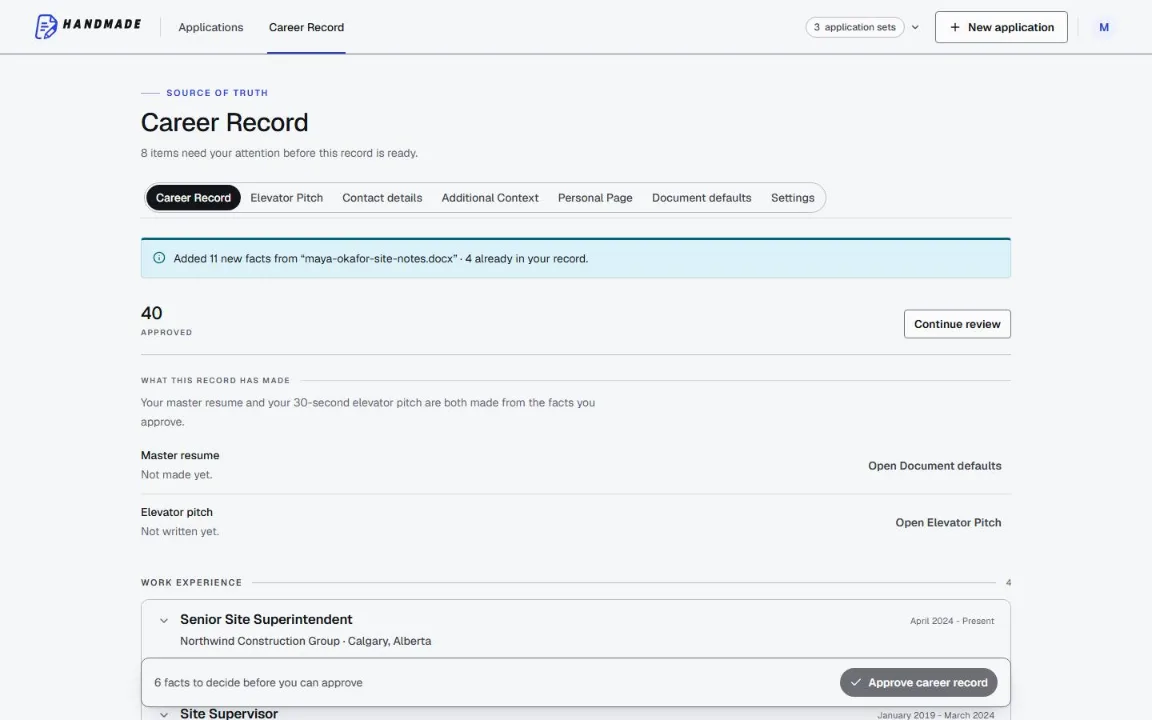
Keep your full work history in one Career Record, then tailor the top of your resume for the role you want. You can edit every line before downloading a format-checked PDF or DOCX.
What you get, exactly: We build one English-language resume or CV from your Career Record, on Letter-size pages (the DOCX is editable if you need A4), single column, with real selectable text. It is not a market-localized document: we do not translate it, we do not add a photograph or a personal details block for a market that expects one, and we never fill in a government application form.
2 complete application sets free, at the same quality as a paid plan. No card required.