Indian resume format: what actually belongs on it
A modern Indian resume, the biodata it gets confused with, and why identity numbers never belong on it.
7 minute readPublished Updated
Short answer
A modern Indian corporate resume reads like a corporate resume anywhere: contact details, a short summary, reverse-chronological work history with specific results, skills, then education. Biodata is conventionally a separate form a public-sector employer hands you, not a resume under another name, and identity numbers belong on neither. Class 10 and Class 12 aggregates earn their space early in a career and come off once real work sits behind you.
Do this next
- Work out whether you are answering a private posting or a published proforma.
- Take Aadhaar, PAN, passport, bank and provident fund details off the page.
- List Class 10, Class 12 and degree aggregates while you are early in your career.
- Keep the declaration line for government submissions and drop it for corporate ones.
- Leave notice period and cost to company for the form or the conversation.
What does a modern Indian resume look like?
It looks close to a corporate resume anywhere: name and contact details at the top, a short summary if you have something worth summarising, work history in reverse chronological order with specific accomplishments, skills, and education. Single column, plain headings, no photo by default, no decorative side panels.
The advice that makes Indian resumes look strange is imported from two places, and neither applies to the job you are probably applying for. One is the government application form, which is a different artefact with its own rules. The other is international advice about a market whose hiring nobody writing it had looked at. A private employer in Bengaluru or Pune is reading something much closer to what an employer in Berlin or Boston is reading than either source suggests.
Is biodata the same thing as a resume in India?
No. Biodata is conventionally a form, and in Indian hiring it commonly belongs to government and public-sector recruitment, where the employer publishes the proforma and you fill it in. It typically asks for things a resume would not: father's or husband's name, date of birth plus age calculated to a cut-off date, reserved category, education listed from Class 10 with a marks column, a pasted photograph, and a signed certification at the end.
You do not design a biodata. You are handed one. If a department or a public-sector employer wants that format, the notification commonly says so and the file is attached to it. If a private employer asks for your resume, they mean a resume, and stuffing it with biodata fields makes you look like you are applying for a different job at a different kind of organisation.
The same word also commonly names the family-introduction document used in arranged marriages, which is part of why searching for a biodata format returns such a confusing mix of results. Three different documents, one word, and a lot of advice written by people who did not notice.
Should your Aadhaar or PAN number go on a resume?
Never, and the same goes for your passport number, bank details, provident fund account, and any scan of an identity document. A resume is a file you deliberately lose control of. You send it to strangers, they forward it internally, it lands in inboxes and shared drives and third-party portals, and none of that is under your control once you press send.
These numbers are not secrets the way a password is, but they are identifiers that open doors. A masked Aadhaar, which replaces the first eight digits and shows only the last four, exists for a reason: the full number is worth protecting. Recruitment can also be convenient cover for identity fraud, so an early unsolicited request for documents is a warning sign rather than a formality.
An employer may have legitimate reasons to collect some of this, at the point of an offer or during onboarding, through their own channel. That is a different moment and a different document. Nothing about it requires the number to be sitting inside a file you have been mailing to unknown recipients for months.
- Aadhaar number, PAN, passport number, and voter ID.
- Bank account, UAN, or provident fund details.
- Date of birth, and any scanned identity document.
- Marital status, religion, and reserved category.
- Father's or husband's name.
- Full residential address; your city and state are enough.
Source: What is Masked Aadhaar?, Unique Identification Authority of India
Do Class 10 and Class 12 marks belong on an Indian resume?
Early in a career, yes, and this is the one place where advice written for other markets can actively cost you. Campus recruiters in India commonly publish eligibility criteria against three numbers: your Class 10 aggregate, your Class 12 aggregate, and your degree aggregate or CGPA. Those criteria conventionally set a minimum aggregate for each, often alongside a requirement to have cleared every stage at the first attempt with no pending backlogs. A resume that leaves them out forces someone to ask, and some processes will simply not ask.
So a fresher lists school and board, year, and the aggregate for each of Class 10 and Class 12, then the degree with its aggregate or CGPA. Backlogs and breaks in education are worth stating rather than hiding, because eligibility criteria usually require you to declare them and verification commonly happens against your original mark sheets anyway.
That section then shrinks fast. Once a few years of real work sit behind you, education moves to the bottom of the page and compresses to the degree, the institution, and the year. Class 10 percentages on the resume of someone with eight years of experience read as padding, because that is what they are.
Do you still need a declaration and signature?
It depends entirely on who is reading. The declaration line, the one stating that the information above is true to the best of your knowledge, followed by place, date, and your name, is still commonly expected in government departments, educational institutions, uniformed and medical services, and anywhere the employer hands you a structured application form. Leaving it out there can look like an incomplete submission.
In private-sector corporate applications it has largely gone in practice. It asserts nothing the employer would not already assume, it eats the space at the bottom of the page where something useful could sit, and it signals that the resume came from a template built for a different process. Drop it in that context without worrying about it.
If you are applying into both worlds at once, keep two versions rather than compromising on one. The government-facing version carries the declaration and follows whatever proforma is attached to the notification. The corporate version does not, and gains a couple of lines of real content instead.
Where do notice period and current CTC actually go?
Not on the resume. Both get asked, often in the application form itself and often before anyone has read your resume properly: current cost to company, expected cost to company, and how long your notice period runs. Portals and application forms commonly carry them as their own fields, sometimes as a figure or a range you pick from a list.
Answer them there rather than printing them on the document. A salary figure on a resume anchors every later conversation to it and travels with the file everywhere it gets forwarded. A notice period stated flatly on paper loses the context that makes it workable, whereas in a conversation you can say what is negotiable, whether a buyout is possible, and when you could realistically start.
If a field forces a number out of you, give a range and mark it negotiable. If a recruiter raises it early, answer plainly rather than dodging: the question is a budget check, and dodging only delays the same conversation to a point where both sides have spent more time.
Common questions
Should an Indian resume be one page or two?
Do I need a photo on my Indian resume?
Is it a CV or a resume in India?
The employer sent me a biodata proforma. What should I do?
Use this in Handmade Resume
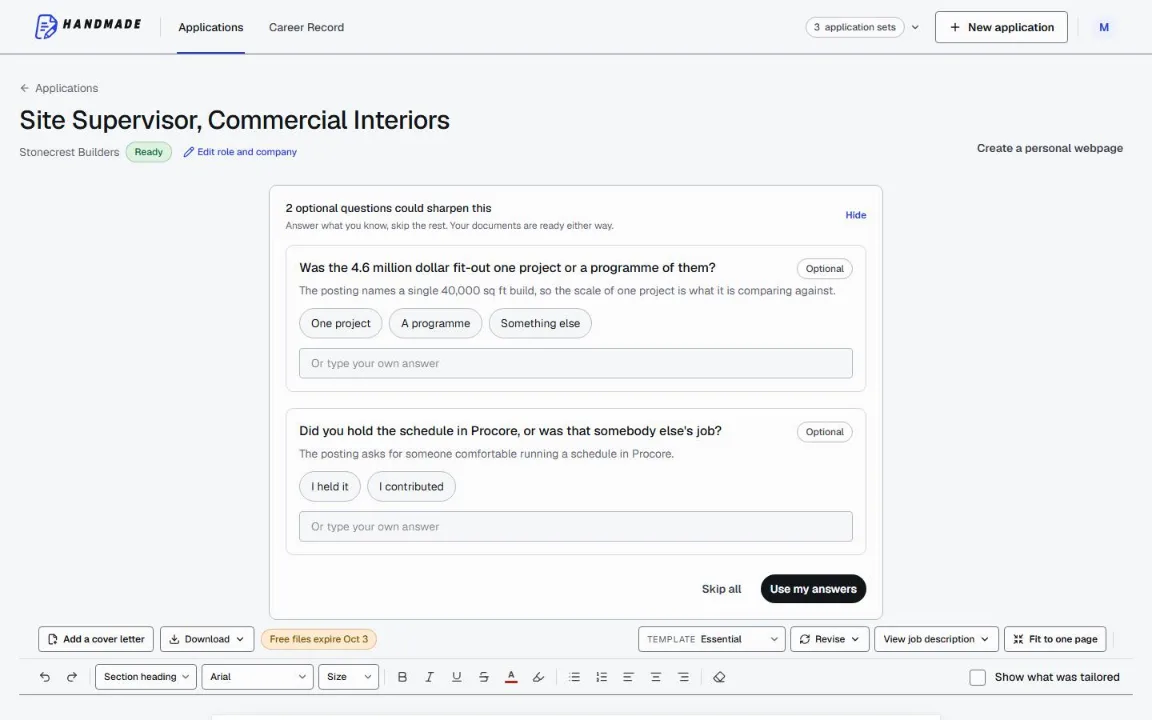
Keep your full work history in one Career Record, then tailor the top of your resume for the role you want. You can edit every line before downloading a format-checked PDF or DOCX.
What you get, exactly: We build an English resume on Letter-size pages (the DOCX is editable if you need A4) with real selectable text, from the facts you approved. It is not a biodata proforma and not a public-sector application form: nothing here adds a photograph, a date of birth, a category field, or a declaration and signature block on your behalf.
2 complete application sets free, at the same quality as a paid plan. No card required.