UK CV conventions: what British employers expect
Length, the personal statement, references, what to leave off, and what an agency does before the client looks.
8 minute readPublished Updated
Short answer
In Britain a CV is the ordinary document you send for any job at any level, at around two A4 pages, and only university and research posts commonly want the long scholarly version. It opens with a short personal statement under your contact details, and it leaves off age, date of birth, marital status, nationality and a photograph. Agencies commonly strip your contact details and reformat the file before a client ever sees it, so plain structure is worth more than layout.
Do this next
- Aim at two A4 pages, unless the advert states a limit of its own.
- Write three lines of personal statement directly under your contact details.
- Take out age, date of birth, marital status, nationality and any photo frame.
- Keep a referee's telephone number off the page until somebody asks for it.
- Keep a plain Word version for anything going through a recruitment agency.
In Britain, CV means the ordinary job application document
A CV in the United Kingdom is in practice what you send for every job at every level: a shop supervisor, a graduate scheme, a finance director. It is not an academic-only word and it does not mean a long scholarly record. That is the trap waiting for anyone working from American material, where CV means the full academic, research, scientific or medical record and the everyday document is a resume.
The trap runs in both directions. An American reading their own market's definition sees a British advert asking for a CV and either sends a scholarly document for an ordinary commercial job, or panics and assumes there is a British format they have never heard of. A British applicant sending a two-page CV to a US employer meets the opposite problem, where the word is understood but the document looks longer than expected.
The academic exception exists and is narrow. University and research posts in Britain commonly want the long version, often running to three pages and beyond, with publications, funding, teaching and service listed in full. Everywhere else, a CV is conventionally around two pages and is selected for the job in front of you.
How long a UK CV should be
Two A4 pages is the centre of gravity, and it is a centre of gravity rather than a rule. Students applying for part-time work should be shorter. Academic CVs are longer by design. Any page limit stated in the advert replaces all of this, and a stated limit is the one length instruction that is genuinely enforced.
The one-page argument runs in Britain too, so anyone telling you the United States uses one page and Britain uses two is describing a difference in average rather than a national dividing line. What both sides of that argument agree on is that padding is the actual problem: a thin two-page CV reads worse than a dense one-page CV, and a strong second page reads as depth.
The workable rule is the same one that applies to length anywhere. Page one has to carry the decision, so your personal statement, your current role and your strongest evidence all sit above the fold, and page two exists for the detail somebody reads once page one has already worked.
The personal statement at the top
British CVs conventionally open with a short personal statement, sometimes labelled a profile or simply an introduction, sitting directly under your name and contact details. It is a few short lines saying who you are and what you are looking to do next. This is a conventional section with no direct North American equivalent, and leaving it out can make a CV look like an imported document.
It is not an American objective statement, and importing one is a double mistake: the objective says what you want from an employer, and it is out of fashion in its own home market anyway. A personal statement says what you are and what you bring, aimed at the specific posting, and the reader is screening for what they need rather than for what you are hoping for.
Three lines is enough. Name the role you are applying for or the work you do, give one concrete piece of evidence that could only be about you, and finish with the direction you are moving in. If your statement would fit any candidate in your field, it is not doing anything and the space is better spent on a bullet.
Source: How to write a CV, National Careers Service (UK government)
References, and the phrase that is not dead in Britain
Advice written for North America calls references available on request obsolete, and it circulates widely enough that British applicants delete the line on its authority. In Britain the line is not obsolete. It is conventional, it is not commonly held against you, and it travels with a rule worth following anywhere: do not put a third party's contact details on a document that circulates without their knowledge.
North American practice runs the other way and is just as settled. References belong on a separate sheet and go out only when they are specifically requested, which means the line has nothing to do on the page at all. That is where the never write it rule comes from, and it is sound where it was written. One sentence, two opposite conventions, each defensible in the market that produced it.
British practice is genuinely split in the middle, and neither choice is commonly penalised. Include the line if you have a referee lined up or if you want the space accounted for; leave it out if you would rather use the line for evidence. What is not split is the part about other people's phone numbers, which stay off the page until an employer asks.
Source: How to write a CV, National Careers Service (UK government)
What to leave off a UK CV
The omissions are the most specific part of British CV convention, and they are the opposite of what a German template would prompt you for. Leave off your age, your date of birth, whether you are married, and your nationality. Photographs sit in a different category. The no-photograph norm is a professional convention rather than a rule you will find written down in the same places, and a photo mostly signals unfamiliarity with local practice.
Get the legal framing right, because the version repeated online is wrong. UK equality law binds employers' conduct and decisions, not your disclosure. It does not make it unlawful for you to put your age on a CV. Omitting these details is standard practice that removes information nobody should be deciding on, which is a better reason than a legal one and does not depend on the law. Age is the one protected characteristic where less favourable treatment is not direct discrimination if the employer can show it is a proportionate means of achieving a legitimate aim, which is a reason to leave the field off rather than a reason to worry about it.
- Age, date of birth, marital status and nationality.
- A photograph, and any template frame left behind where one used to sit.
- Your National Insurance number. It is to be shared only with someone who needs it, and an employer needs it once you are hired rather than on a CV, so treat an early request for it as a warning sign.
- A full postal address. Name, one phone number, an email address and a professional network profile link are enough.
- Anyone else's contact details, including referees, until they are asked for.
- Translated grades. Leave GCSEs, A levels and a 2:1 as they are, because converting them to another country's scale can read as inflating them.
Sources: How to write a CV, National Careers Service (UK government); Equality Act 2010, section 13 (Direct discrimination), legislation.gov.uk; Your National Insurance number, GOV.UK
What a recruitment agency does to your CV before a client sees it
Much British hiring runs through recruitment agencies, and the document the hiring manager reads is often not the document you sent. Agencies commonly reformat a candidate's CV before passing it on: your name, address, phone number and email are stripped out so the client cannot go round the agency and hire you directly, agency branding is pasted across the top, and your layout is broken in the process. A carefully spaced two-page design can arrive at the other end as six pages of misaligned text. This is also a reason agencies often ask for an editable Word file rather than a PDF.
The consequence changes what you should spend your effort on. For an agency application, layout investment is wasted, because the layout is going to be overwritten. What survives a rewrite is structure: real section headings, one column, reverse chronological order, plain consistent dates, and bullets that are actually bullets rather than manually indented lines. A design that leans on columns, sidebars, text boxes or icons is the one most likely to come out the other side as nonsense.
Two habits follow. Never let anything essential live only in a header or footer, since those are the first things stripped and the last things a converter handles well. And keep two versions: a plain, structurally clean file for agency submissions, and your polished PDF for applications you send direct to an employer.
This is also where our documents earn their keep in this market. They are single column with real headings and selectable text in one reading order, which is the shape that survives being converted, stripped and re-branded. If you want a rough sense of what an agency's converter will have to work with, copy the text out of your finished file and paste it into the text preflight, which reads the words you paste rather than the layout of the file.
Common questions
Should a UK CV be one page or two?
Do I put a photo on a UK CV?
Should I write references available on request?
Source: How to write a CV, National Careers Service (UK government)
Is it illegal to put my age on a UK CV?
Source: Equality Act 2010, section 13 (Direct discrimination), legislation.gov.uk
Should I send a PDF or a Word file to a recruitment agency?
Use this in Handmade Resume
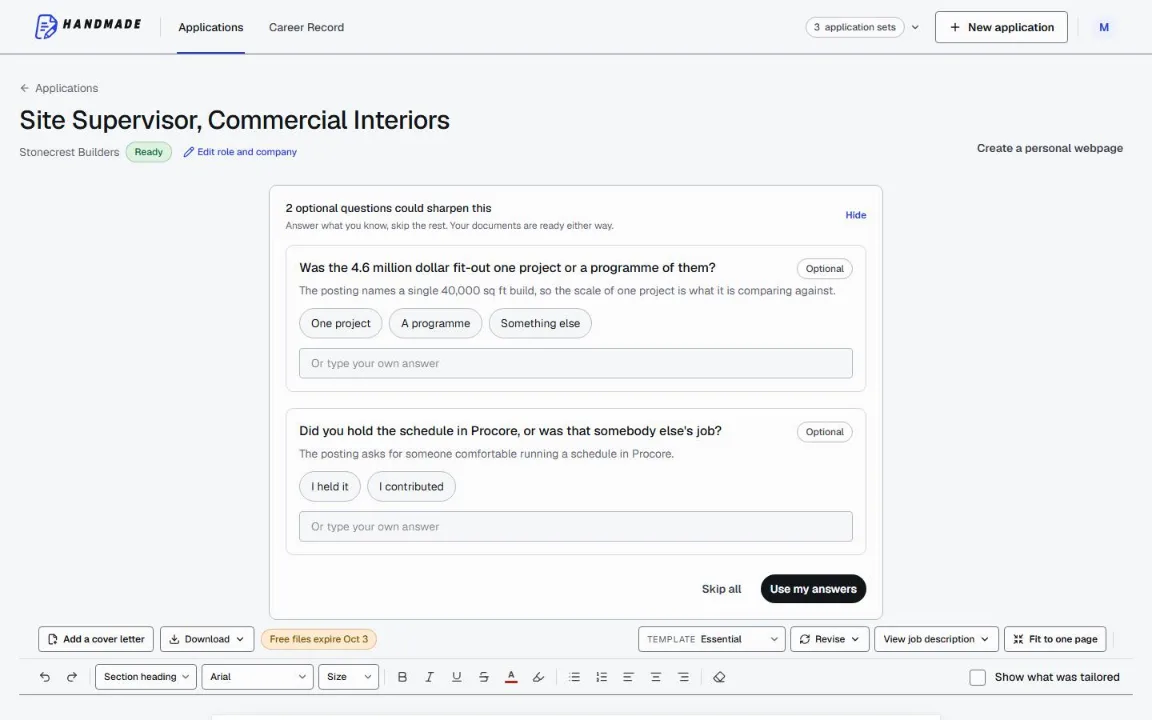
Keep your full work history in one Career Record, then tailor the top of your resume for the role you want. You can edit every line before downloading a format-checked PDF or DOCX.
What you get, exactly: We build an English CV on Letter-size pages (the DOCX is editable if you need A4), single column, with real selectable text and a statement block at the top. We do not add a British referees section, complete an employer's own application form, or produce the re-branded version a recruitment agency will make from your file.
2 complete application sets free, at the same quality as a paid plan. No card required.