How to write resume bullet points that survive scrutiny
A structure for bullets that lead with outcomes, stay specific, and survive the interviewer's follow-up question.
7 minute readPublished Updated
Short answer
Give each line one thing you personally did, opening with the action or the result and following it with the scale and the method. Choose the verb that matches the ownership you actually had, because that is the claim an interviewer tests first. Where no real figure exists, name the system, the audience, or the thing you produced instead.
Do this next
- Pick one accomplishment and write it out long, with everything you remember.
- Move the outcome, or the action if there was no outcome, to the front.
- Replace the verb with the one that matches what you were responsible for.
- Add only the scale you could reconstruct if someone asked you to.
- Read it back and keep it if you would enjoy the follow-up question.
The job of a bullet
Each bullet answers one question: what did you do that this employer should care about? Not what your team did, not what your job description said, and not a category of activity ('various reporting tasks'). One concrete contribution per line.
The reader's follow-up is always the same: 'tell me more about that.' A good bullet is one you would enjoy expanding on. If a line would make you flinch in an interview, it is wrong on the resume, whatever it does for the screen.
A structure that works
Lead with the action or the outcome, then the scope, then the method: 'Cut invoice processing time from five days to two by consolidating three approval steps into one reviewed workflow.' Outcome, scale, how. The order can flex; the ingredients should not.
Verbs carry ownership claims, so pick them precisely. 'Led' means you were accountable. 'Built' means your hands made it. 'Contributed to' and 'supported' are honest and respectable when that is what happened; an inflated verb is a common resume falsehood and the one an interviewer punctures fastest, with a single follow-up question.
Bullet Evidence Builder
Enter what you actually did and got. This arranges your exact words into a bullet scaffold. It never rewrites your verbs or invents a number.
Use your own verb. This tool never changes it.
Only a number you can back up if asked.
Pick how you were involved. This word is kept exactly, never upgraded.
Numbers: use real ones or none
Quantified bullets are stronger, which is exactly why invented numbers are so tempting and so damaging. Use figures you measured or can reconstruct honestly, with their context (over what period, against what baseline). Ranges and approximations marked as such ('roughly 40 reports per month') are perfectly credible.
When there is no honest number, specificity substitutes: name the systems, the stakeholders, the deliverable. 'Wrote the onboarding runbook now used by the support team' has no digits and plenty of evidence.
Editing checklist
Draft bullets long, then cut. A strong bullet usually lands between one and two lines; a three-line bullet almost always contains two claims that read better separated.
- One claim per bullet; split compound accomplishments.
- First word is a precise verb in the right tense (past roles, past tense).
- Every number is real, contextualized, and defensible.
- No pronoun 'we' hiding who did the work; state your part.
- Reads clearly to someone outside your company; internal jargon translated.
- You would welcome a follow-up question on it.
Common questions
How many bullets per role?
Should every bullet have a metric?
Can AI write my bullets?
Use this in Handmade Resume
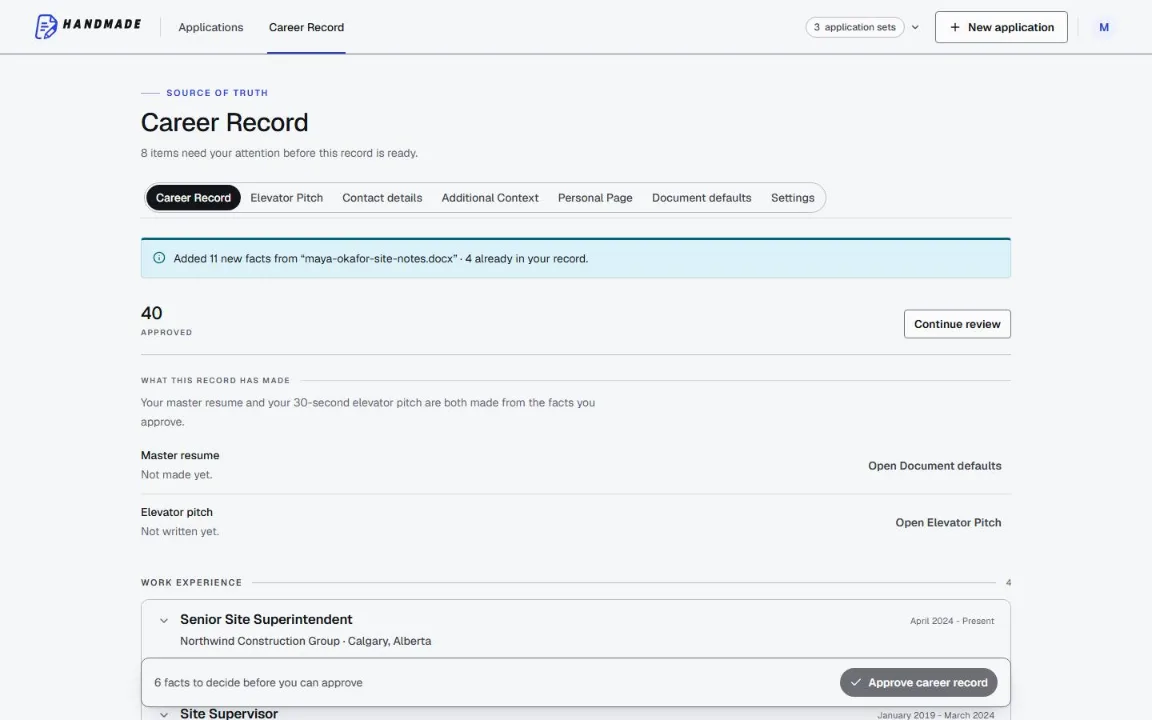
Keep your full work history in one Career Record, then tailor the top of your resume for the role you want. You can edit every line before downloading a format-checked PDF or DOCX.
2 complete application sets free, at the same quality as a paid plan. No card required.