Resume tips that hold up, and the ones that do not
Which advice changes what a reader can verify about you, which is cargo cult, and what outranks both.
9 minute readPublished Updated
Short answer
Sort any tip by one question: does it change what a reader can verify about you on a fast first pass, or only how the page feels? Turning a duty into an outcome and moving your strongest evidence upward pass that test; fonts, colour accents and synonym hunting do not. And how an application arrives outranks how it is written, so an hour spent finding one person inside the company beats a fifth rewrite.
Do this next
- Look at your last three edits and ask which one a reader could verify.
- Proofread the whole page, then hand it to somebody else to read cold.
- Drop the objective line, the references line, and any hidden keyword block.
- Lift the evidence that answers this posting into the top third of page one.
- Give the last hour of the evening to the door rather than to the document.
Sort the advice before you take any of it
Most resume advice is repeated because it is repeatable, not because anyone checked it. Here is a filter that does the sorting for you: does this tip change what a reader can verify about you on a fast first pass, or does it only change how the page feels? The first kind is worth an evening. The second kind is why people rewrite the same document five times and change nothing.
Run the filter on anything you are about to spend time on. Rewriting a duty as an outcome changes what a reader can verify. Moving your strongest role above a weaker one changes what a reader sees first. Changing the font, adding a colour accent, and hunting for a stronger synonym change neither.
The tips below are sorted that way: the ones that survive the filter, the ones that do not, and the one variable that outranks the whole document.
Should every bullet have a number?
No, and forcing it is how invented figures end up on resumes. A number is worth putting on the page when you could answer 'how did you measure that?' without flinching. Otherwise it is a liability, because the first follow-up question opens the gap between the figure and the work.
Readers split on this in practice, and the split comes from two different audiences. A specialist reading your work knows what a change can and cannot move, so a business metric bolted onto a narrow technical task reads as inexperience. A manager reading for outcomes wants the revenue or the cycle time stated plainly, and treats the interview as the place to find out whether you moved it.
Both positions collapse into the same instruction: attach a figure only to work you own, and be specific instead where you cannot.
- Safea figure you measured, with its period and its baseline. 'Cut month-end close from ten days to six across two quarters.'
- Riskya business metric attached to a task you contributed to. The first follow-up question opens the gap.
- Better than a weak numberthe specific thing. 'Wrote the onboarding runbook the support team still uses.'
- Nevera percentage you reconstructed afterwards because the line looked bare without one.
- Test each line by imagining your interviewer reading it back to you. Proud or embarrassed is a reliable signal.
The variable that outranks the whole document
How your application arrives matters more than how it is written, and the reason is mechanical. A cold application joins a queue somebody has to get through. A referred one arrives with a name attached, from a person the employer already trusts, and it is commonly looked at because that person asked rather than because it reached the top of a pile. Those are two different applications, not one application written better.
That does not make your resume irrelevant. It makes it the second variable, and the consequence is an allocation decision. An hour spent finding one person inside a company who will pass your name along usually beats a fourth pass over your bullet points.
So treat the two as sequential rather than competing. Find the door, then send something worth reading through it. A referred candidate with a vague resume arrives with an advantage and then spends it in the first ten minutes of the call.
Tips that survive scrutiny
These change what a reader can verify, or they follow from a mechanism that is obviously true once stated. None of them is exciting, which is roughly the point.
- Proofread it, then have someone else read it. Nothing else on this list is as cheap to fix, and a typo in a document you had unlimited time to check is the easiest thing on the page for a reader to hold against you.
- Keep the structure plain and single-column. A columned design is a common reason a file fails to extract into text, because the reading order has to be reconstructed before the words can be read, and it is harder for a person to skim too.
- Put the evidence that answers this posting in the top third of page one, and assume the rest is read only after that top third has worked.
- Write so a non-specialist can follow it. The first person to open your application often does not work in your field and cannot decode an internal project name.
- Do not list anything you would not enjoy being asked about. That covers skills clouds, tools you touched once, and side projects you have not opened in three years.
- Use a summary rather than an objective, and make every clause in it checkable.
- For a formatting baseline that stays out of the way: half-inch to one-inch margins, ten to twelve point type, and only as many bullets per role as you have real accomplishments for.
- Keep one long record of everything you have done, with real dates, and draw each application from it rather than from memory.
Tips that are cargo cult
Each of these is repeated constantly, and each one either has nothing behind it or targets a mechanism that does not work the way the tip assumes. Dropping all of them frees an evening for the list above.
- 'You have exactly six seconds.' No number here is established, and a figure passed around without its method behind it is not a rule you can plan on. The true part is only that page one gets a fast first pass.
- 'References available upon request,' if you are applying in North America. Keep references on a separate sheet and offer them when they are asked for. British practice commonly still accepts the line, so this one is genuinely local.
- 'Open with an objective.' The reader is screening for what they need, not for what you want. A summary made of checkable clauses does the same job and carries information.
- Keyword density targets. Whether a system scores anything, and what it does with a score, depends on the employer's configuration, which nobody outside can see, and no employer publishes a density to aim at. Terminology matters most for whether a recruiter can find you in a search later.
- White text and hidden keywords. Parsers extract text, so hidden text lands in the reader's plain-text view. It is not hidden from the person you are hiding it from.
- A striking designed template. Multi-column layouts are harder for a person to skim and are a common cause of failed text extraction. The famous designed resumes that worked tend to have worked because of who was behind them.
- Power-verb lists. Swapping 'managed' for 'spearheaded' changes nothing a reader can verify, and every other applicant is working from the same list.
What to do this week, in order
If you only get one evening, spend it in this order. Each step uses material you already have, and each one changes what a reader can verify rather than how the page feels.
- Write down every role, project, credential, and number you can defend, with real dates. This is the record everything else draws from.
- Pick one posting you actually want, and list its requirements as plain phrases.
- Against each requirement, name the one thing in your record that proves it. Where nothing does, leave the requirement alone rather than inventing a match.
- Rewrite the summary and the first three bullets so that mapping is visible in the top third of page one.
- Delete anything you would not enjoy being asked about, then check every date and number against your own records.
- Export it, open the file, and select the text to confirm it is really text before you attach it.
- Then find one person inside the company. That step is worth more than a fifth rewrite.
Common questions
Should every bullet have a number?
What is the highest-value change I can make today?
Is tailoring every application worth the time?
Does an applicant tracking system throw my resume out over formatting?
Do cover letters still matter?
If referrals matter that much, why work on the resume at all?
Use this in Handmade Resume
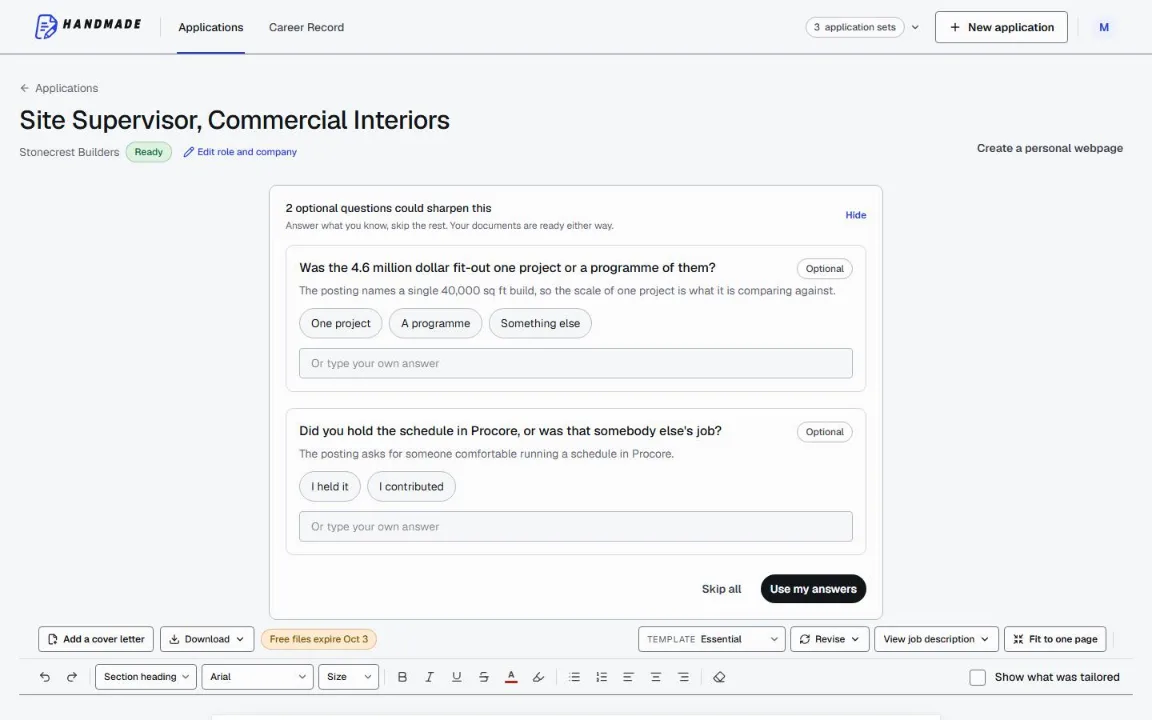
Keep your full work history in one Career Record, then tailor the top of your resume for the role you want. You can edit every line before downloading a format-checked PDF or DOCX.
2 complete application sets free, at the same quality as a paid plan. No card required.