How to make a resume stand out to a human
Standing out means being the obvious answer to one posting, not being visually unusual.
8 minute readPublished Updated
Short answer
Standing out means being the obvious answer to one posting, read quickly, by somebody who is not concentrating yet. It comes from detail only you could have supplied, placed where it is seen first, and never from colour, columns, or a headshot. The same page is unmistakable in one competition and forgettable in the next, so the question has no answer until you name the job.
Do this next
- Cover your name, read your own summary back, and delete it if it fits anyone.
- Write out what this posting is asking for, as plain phrases in your own words.
- Put the strongest thing you have already done directly under each phrase.
- Trade an adjective for a noun: the system, the document, the customer.
- Take out the colour, the extra column, and the headshot. They cost you twice.
What standing out actually means
A resume stands out by being the obvious answer to one posting, read quickly by somebody who is not concentrating yet. Being unusual is a different goal and a worse one, and every paragraph below comes back to that difference.
How carefully anyone reads depends on the pipeline, and you rarely know which one you are in before you send. A small specialist team reads properly. A high-volume corporate funnel gives page one a quick first read and decides. So write for the fast reader without making the document useless to the careful one: the top third carries the decision, and the depth underneath rewards anyone who keeps going.
In either funnel, one specific, checkable detail beats three impressive-sounding ones. That is the whole method, and the rest of this page is how to apply it.
Most stand-out advice is decoration
The advice industry answers 'how do I stand out' with visual difference: a two-column layout, a colour accent, a skills dial, a headshot, an infographic. It runs the wrong way, and it runs the wrong way twice.
Cluttered multi-column resumes are the hardest for a human reviewer to skim, and a columned design is a common cause of a file that fails to extract into text, because a parser has to reconstruct the reading order before it can read anything. The decoration you would add in order to be noticed is the same decoration that costs you with the person and with the software. A plain, single-column page leaves the memorable part visible.
A striking template that worked for somebody else is also weak evidence, because the design usually was not the thing doing the work. With a quirky document the upside and the downside are the same event: it gets remembered either way, and you do not control which.
Specificity is the differentiator that survives
What makes a resume memorable to a person is detail that could only be about you. Not stronger adjectives. Nouns: the system you named, the process that stopped breaking, the document other people still send, the customer who stayed.
Run the cover test on your own summary. Cover your name and read it back. If a hundred other applicants could publish the same sentence truthfully, it is not describing you, and that space belongs to your first role instead.
- Generic'Experienced operations professional with a proven track record.'
- Specific'Moved four warehouse sites onto one inventory system without a stock freeze.'
- Generic'Excellent communicator with strong stakeholder skills.'
- Specific'Wrote the client onboarding guide three teams now send to every new account.'
- Neither specific version carries a number. It is harder to write and impossible to confuse with anyone else's.
- The raw material is always the samename the thing, name who used it, name what changed because it existed.
Relevance to one posting beats polish across fifty
A resume that answers this job is more distinctive than a resume that is well written in general, because the reader is comparing you against a description rather than against an ideal. That is a reordering job before it is a writing job: the same facts, put where they answer the question being asked.
The reordering is cheap and people skip it anyway, because moving a paragraph does not feel like improvement. It is. Read the posting, list its requirements as plain phrases, and for each one put the strongest thing you have already done directly under it in your top third. Where you have nothing, leave the requirement alone rather than manufacturing a match.
This is what our tailoring step automates: the posting is broken into requirements, each one is mapped against facts you have already approved, and the employer's terminology is used only where your record supports it. Doing it by hand works too; it is slow, repeated work for every posting, which is the cost the step takes off you by working from the record you approved once.
Evidence under every claim
Anything asserted at the top has to be demonstrated further down, or it drags the credible parts down with it. A reader tends to discount the whole header, not just the weak line.
Test each line as a conversation. Would you be glad if the interviewer opened with it? A skills list you cannot discuss item by item is a set of questions you volunteered to be asked. An ownership claim you cannot describe end to end will not survive the second follow-up.
This is the boundary the product enforces rather than suggests. Every generated line is checked against the facts you approved: a line that reaches past your record is written back down to what the record holds, and one that still needs your review is pointed out rather than quietly shipping as it stands.
Distinctiveness Audit
Tick what is true of your resume today. Get the fixes in the order they are worth doing, and the reason for that order.
Which of these is true of your resume right now?
What the document cannot do, and what only it can
A page about standing out should say where the document's influence ends. How your application arrives outranks how it is written, because a referral commonly changes which queue your file lands in before a word of it is read. The most distinctive version of your document, sent cold, is still a cold application. Our resume tips page works that argument through and says what it means for how you spend an evening.
What is left for the document is the part no introduction can do for you. Standing out is not a property your resume has. It is a relation between your resume and one posting. The same page is unmistakable in one competition and forgettable in the next, because the reader is not ranking you against every applicant alive, only against the shortlist for this description. Which is why 'how do I make my resume stand out' has no answer until you name the job.
Find the door first, then be the obvious answer once you are through it. A referral gets your document opened and buys you a careful reader. It does not decide what that reader concludes, and it will not rescue a page that could have been sent to forty other postings unchanged.
Common questions
Does a creative template help me stand out?
How do I stand out with no unusual experience?
Should I add colour or a photo?
What is the fastest change that makes a resume more distinctive?
Do the people reading actually notice the difference?
Use this in Handmade Resume
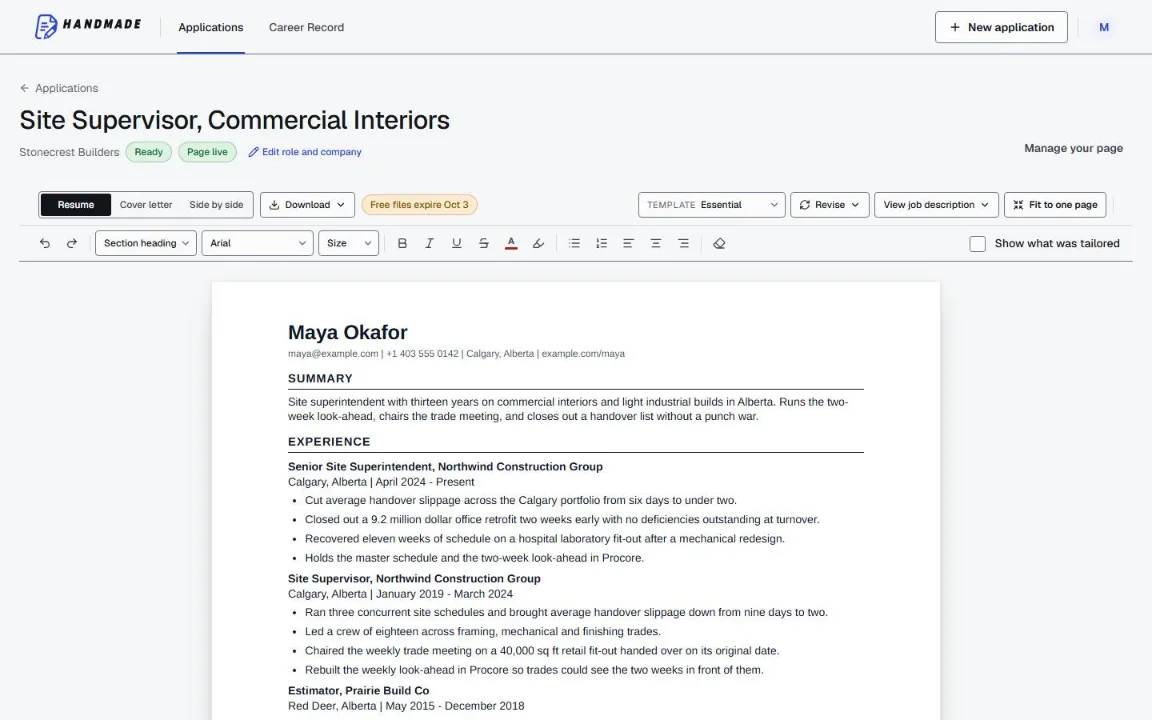
Keep your full work history in one Career Record, then tailor the top of your resume for the role you want. You can edit every line before downloading a format-checked PDF or DOCX.
2 complete application sets free, at the same quality as a paid plan. No card required.