How to address a cover letter with no hiring manager's name
Find the name if it exists, pick a salutation that is not dated, and open with this employer.
9 minute readPublished Updated
Short answer
Spend a few minutes looking for the name on the posting itself, the employer's team page and the profile of the recruiter named on it, then stop. If nothing turns up, write 'Dear Hiring Manager' or address the team by name, and let the first paragraph do the personalising by naming the role and one specific thing about this employer's work. Never open with 'To whom it may concern'.
Do this next
- Read the posting to its last line; the recruiter or the reporting manager is often named near the bottom or in the instructions for applying.
- Check the employer's team page and the named recruiter's profile for who runs the team you would join.
- Stop after a few minutes and use 'Dear Hiring Manager' or the team's name rather than a guess.
- Open with the role title and one specific fact about this employer's work that you can stand behind.
- Delete 'To whom it may concern' and 'Dear Sir or Madam' wherever they survive.
Find the name if it can be found, then stop
A name is worth a few minutes and no more. Start with the posting itself and read to the end: recruiters often sign the bottom of an advert, the application instructions sometimes name who to send the letter to, and a line such as 'reports to the Head of Support' tells you which role to look up even when it does not tell you who holds it. Then look at the employer's own site, where a team or leadership page may name the person that role reports to.
If the posting names a recruiter, their public professional profile usually says which team they hire for, and that is a legitimate person to address a letter to. For a small company, the founder or the head of the department is findable in a minute and is the right addressee. For a large one, the head of a division is not the person reading your letter, and addressing it to them reads as a guess dressed up as research.
Stop when the obvious places run dry. A wrong name is worse than none: the reader sees a letter meant for somebody else. If you are choosing between two people, or you cannot confirm the spelling and the person's current role, use a general salutation and put the effort into the first paragraph instead.
- The postingthe sign-off, the apply instructions, and any 'reports to' line.
- The employer's team, leadership or about page.
- The public profile of the recruiter named on the posting, which usually says what they hire for.
- For a small company, the founder or the head of the department.
- Stop pointstwo plausible names, an unconfirmed spelling, or a name whose current role you cannot verify.
Salutations that work, and the ones that read as dated
When you have a name, use it with the honorific you can confirm, or use the full name without one: 'Dear' followed by first name and surname is correct, and it avoids guessing at a title or a gender you have not been told. When you do not have a name, the plain options below are all in ordinary use and none of them costs you anything. Pick the most specific one the posting supports.
The dated forms each fail for a reason. 'To whom it may concern' is the opening of a reference letter or a formal notice, written for a reader the writer will never know; on a cover letter it announces that you did not know who you were writing to and did not look. 'Dear Sir or Madam' assumes a formality that business correspondence has largely dropped and guesses at the reader in the process. 'Dear Sir' alone guesses harder. A first-name greeting or 'Hi there' guesses the other way, at a familiarity you have not earned yet.
- 'Dear Hiring Manager'plain, accurate and unremarkable, which is exactly what a salutation should be.
- 'Dear Customer Support Hiring Team' or 'Dear Data Team': the team named on the posting, which shows you read it.
- 'Dear [Company name] Recruiting Team'the company, when the team is not stated.
- 'Dear Search Committee'for academic, public-sector and board roles that name one.
- 'Dear Recruiter' or 'Dear [Agency name] Team': when the advert is from an agency and no consultant is named.
- Avoid'To whom it may concern', 'Dear Sir or Madam', 'Dear Sir', 'Greetings', and any first-name greeting to somebody you have not met.
Opening the first paragraph without a name
When the salutation cannot show that the letter was written for this employer, the first paragraph has to. Three things do it: the exact role title and where you saw it, one specific fact about the employer's work that you can stand behind, and a single clause on why your history fits. The fact is the part that matters. A product you have used, a service you have seen delivered, a public commitment the company has made, a location you know: any of these tells the reader that a person wrote this letter after looking at them.
Two openings to drop. 'I am writing to apply for' spends a line saying what the letter's existence already says, and 'My name is' repeats the signature. Start with the role and the fact. Then test the paragraph. Could you send it to a different employer by changing only the company name? If so, it is not yet written for this one.
Keep the fact modest and checkable. Admiring an employer for being innovative or a leader in its space is flattery the reader has seen in a hundred letters and cannot verify. Noticing that their help centre explains a failed payment in one screen is an observation, and it is yours.
When the posting is anonymous or comes through an agency
An agency posting has two readers in sequence: the consultant who decides whether to forward you, and the client who decides whether to meet you. Address the consultant by name if the advert gives one, and 'Dear Recruiter' or the agency's team if it does not. Write about the role as the advert describes it, not about a client you think you have identified. If you guess the client wrong, the letter is now about the wrong company; if you guess right, the consultant may not want the client named in a letter that was meant to stay confidential. Much hiring in some markets, the UK among them, runs through agencies, so this is an ordinary case rather than an awkward one.
A confidential posting, where the employer is not named at all, leaves you the posting itself. Personalise from what it says: the sector, the size of the team, the problems the role exists to solve. 'Dear Hiring Manager' is the right salutation, and a first paragraph that answers the posting's own description of its problem is as specific as the situation allows. If the application form has no place for a letter, do not force one into another field; the form has told you what the employer wants.
A fictional example opening
The opening below is invented for this page: the employer, the product and the applicant are fictional. It has no name in the salutation and is still plainly written for one employer.
Dear Hiring Manager,
I am applying for the Customer Support Lead role on your careers page. I have used Ledgerpine at two small accounting practices, and what made me want to work on your side of it was watching a colleague resolve a failed payment from one help-centre screen instead of a phone call. For the past four years I have run the support desk at a 40-person practice, where I wrote the reply templates the team still sends and took the escalations that reached a partner. I would like to do that for the people who use your product.
What the paragraph does: names the role and where it was seen, gives one specific observation about the employer that only somebody who looked would make, and places the applicant's most relevant fact beside it. What it does not do: praise the company in adjectives, open with 'I am writing to', or claim anything the applicant's resume would not also say.
Common questions
Is 'Dear Hiring Manager' really acceptable?
Should I phone the company to ask who is hiring?
I found a name but not a title or gender. What do I write?
Can a letter written from my resume still be specific without a name?
What happens if I address the letter to the wrong person?
Use this in Handmade Resume
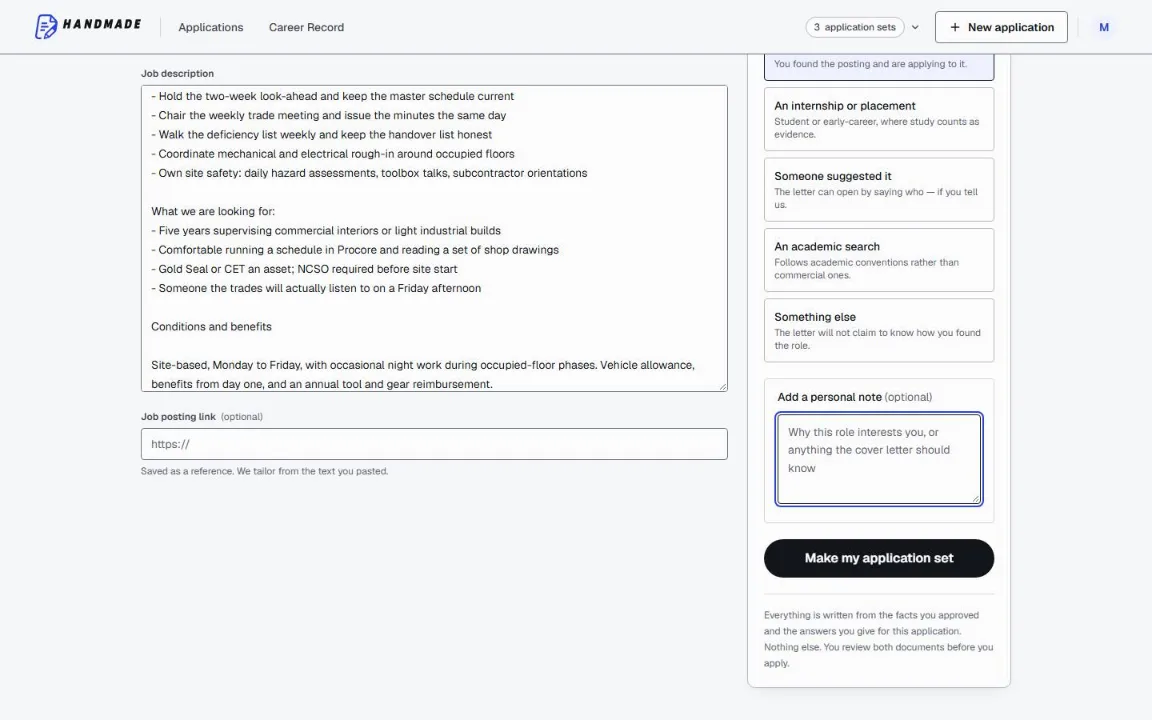
Keep your full work history in one Career Record, then tailor the top of your resume for the role you want. You can edit every line before downloading a format-checked PDF or DOCX.
2 complete application sets free, at the same quality as a paid plan. No card required.