AI resume tailoring without invented experience
A workflow for aligning a resume to a posting while keeping every claim grounded in your own evidence.
7 minute readPublished Updated
Short answer
Keeping a tailored resume honest is a question of sequence. Settle which facts are true before anything is written, match each thing the posting asks for to one of them, and only then let a draft be produced. A requirement with no fact behind it is a gap to describe accurately, never a sentence to improvise.
Do this next
- Break your history into single facts: employer, title, dates, tools, results.
- List what the posting genuinely requires, and mark each one you can already evidence.
- Draft only against the matched facts, and leave the unmatched requirements alone.
- Read every verb in the draft and pull back any that claims more ownership than you had.
Why AI resumes drift from the truth
Language models are built to produce plausible text. When a job description mentions Kubernetes and your resume mentions Docker, a general-purpose chat assistant can bridge the gap and quietly upgrade your experience. It is completing a pattern. The result reads well and interviews badly.
Better prompting does not reach this. As long as the model is free to write any sentence, nothing stops it from describing work you never did. Change what the system is allowed to write, and the problem goes away at the root.
Start from a career record, not a chat
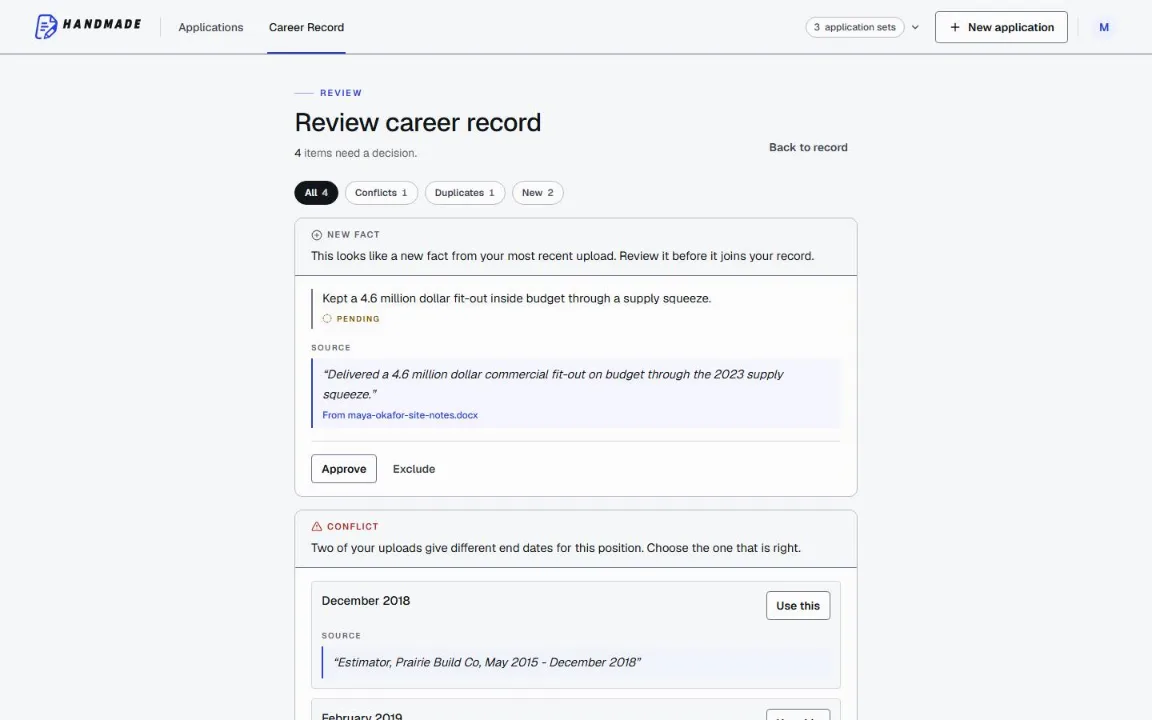
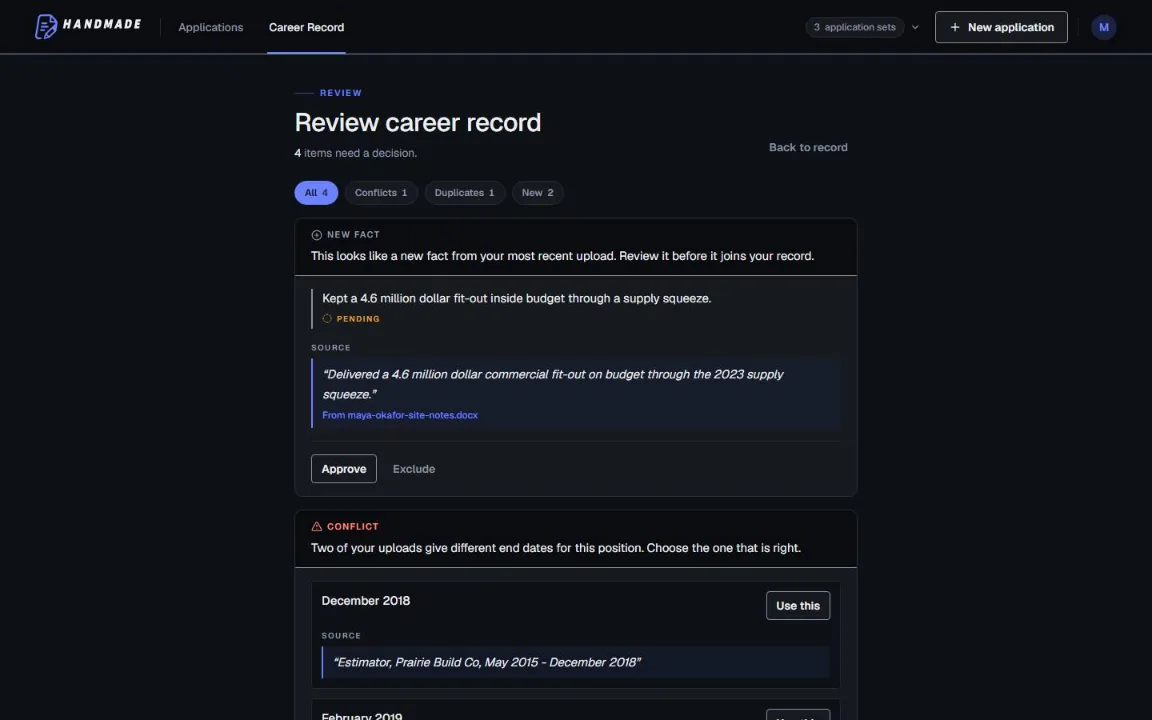
A master resume helps. A reviewed career record is safer. Break your history into discrete facts, so each employer, role, date range, skill, project, credential, and measurable achievement becomes one claim you can approve, correct, or delete.
Approve your facts once, up front, and the honesty check lands at the moment you can do it well, before anything is generated. Reviewing a finished AI resume for invented details is much harder, because fabrications are written in your own voice.
Map requirements to evidence before writing
Read the job description as a list of requirements rather than a bag of keywords. For each requirement that matters, find the approved fact that demonstrates it. Only then should any sentence be written.
A requirement with no supporting fact is a gap. Gaps have three honest treatments: answer a clarifying question if you do have the experience, de-emphasize the requirement if it is optional, or accept that this job wants something you have not done. None of them is 'let the model improvise.'
Review sentences independently of the writer
After drafting, check every substantive sentence against the approved record. Independence is what makes the check real. It has to happen somewhere that never saw the drafting, because a reviewer sharing the writer's context inherits the writer's assumptions and waves through the sentences it would have written itself.
Our guide on checking an AI-written resume for invented claims covers which claims to check, in what order, and what to do with the ones that fail. This workflow assumes you run that pass. Numbers, dates, job titles, employers, credentials, technologies, and ownership verbs carry the risk. 'Led' against 'contributed to' is the difference between a good interview and an awkward one.
Claim Support Check
Mark three tailored claims against one synthetic career fact, then check your marks against the answer key.
Synthetic example
Managed a weekly social-media posting schedule for one product line over about eight months.
For each tailored claim below, mark whether the synthetic fact supports it, whether it needs confirmation against your real record, or whether it is unsupported.
Claim 1. Coordinated a weekly social-media posting schedule for a product line for roughly eight months.
Claim 2. Managed the weekly posting schedule across LinkedIn, Instagram, and X for one product line.
Claim 3. Led the social-media strategy that grew the product line's following by 40%.
What this looks like in practice
This workflow is how our generator is built: you approve a career record once, each application maps the job description to your approved claims, and any answers you give stay with that application. The finished documents are checked against that evidence. Unsupported wording is rewritten down to what the record supports, and a line that still needs review is pointed out rather than dropped. A new fact you type yourself has to be confirmed before it saves. You read the finished draft, and any line the check points out, before you send anything, because automated output can still contain an error. The same checks run on every document, for every account.
You can run the same discipline by hand with any tool. Separate the source of truth from the generator, then separate the generator from the reviewer.
Common questions
Can prompting alone stop an AI from inventing experience?
Is it dishonest to use AI on a resume at all?
What should I do when I almost have a required skill?
Use this in Handmade Resume
Keep your full work history in one Career Record, then tailor the top of your resume for the role you want. You can edit every line before downloading a format-checked PDF or DOCX.
2 complete application sets free, at the same quality as a paid plan. No card required.