Generate a cover letter from a verified resume
Write the letter from the resume you actually send: what to reuse, what to add, what to skip.
6 minute readPublished Updated
Short answer
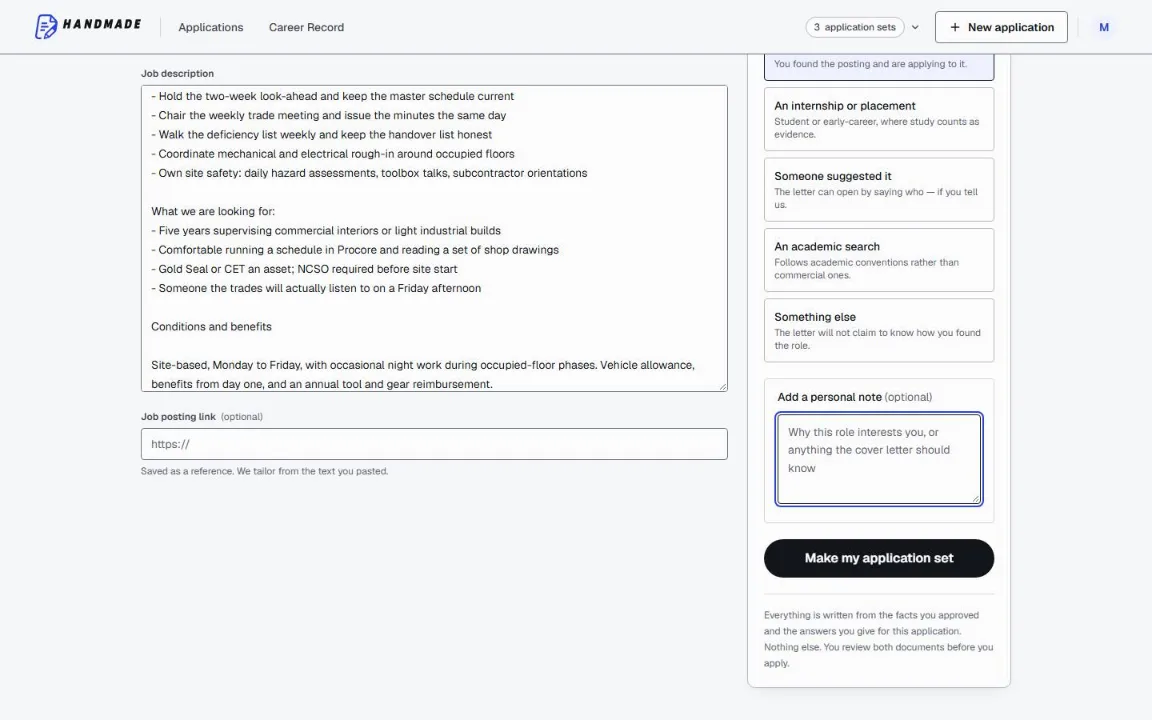
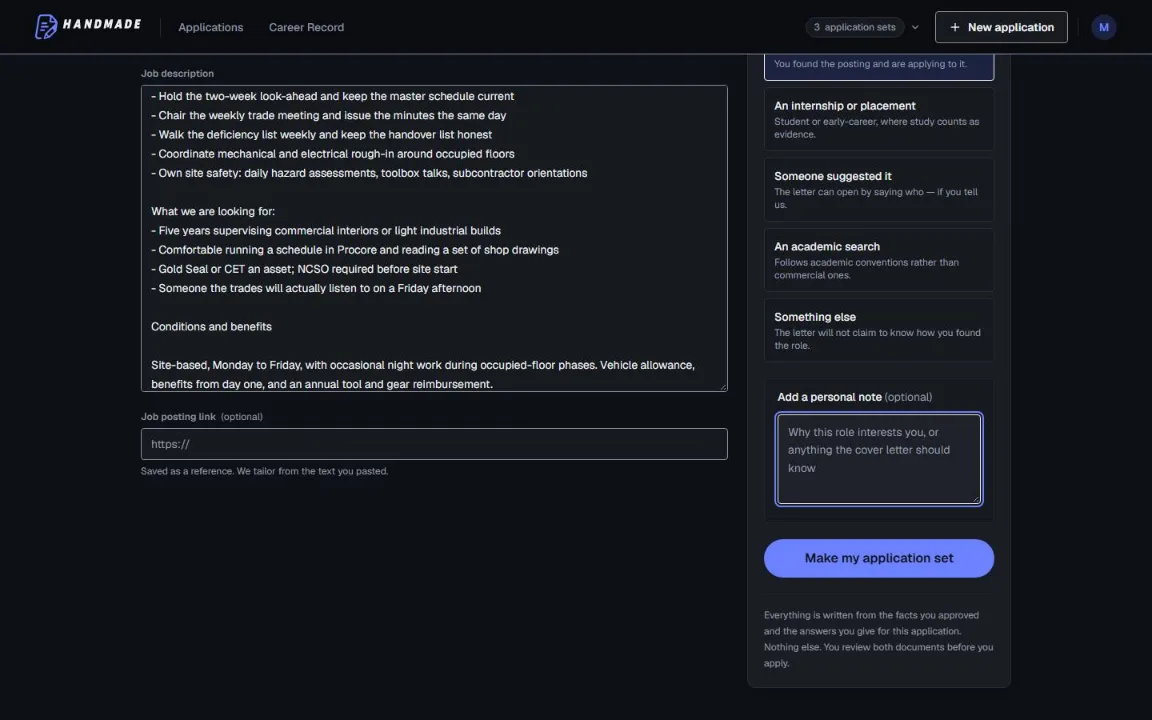
Finish and check the resume first, then write the letter from it, the posting, and your own reason for applying. Built from those sources, plus the direction you keep for letters in your Career Record, the letter has no source to draw an invented accomplishment from, and here its draft is checked against your record before you see it. The one part only you can supply is why you want this particular job.
Do this next
- Settle the resume and confirm every claim on it before you open a letter.
- Pick the two or three duties in the posting that carry the most weight.
- Give each one a short paragraph, drawing only on evidence already in the resume.
- Add your own reason for applying in one sentence, or leave motivation out entirely.
- Read the letter beside the resume and remove anything the two disagree about.
Where cover letters go wrong
Cover letters fail in two directions. Template letters say nothing ('I am excited to apply for this position'). Free-form AI letters say too much, inventing enthusiasm, motivations, and occasionally accomplishments that appear nowhere in your history.
The second failure is worse. A resume claim and a cover letter claim that contradict each other can end an application on the spot, because the contradiction signals that at least one of them is not true.
The resume should come first
Generate and verify the resume before any letter exists. Once the resume has been checked against your approved record, it becomes a small, checked source. Here the letter is written from that finished resume, the posting, the direction you saved for letters in your Career Record, and the optional note you add for the application, so it has no source to draw an invented accomplishment from, and the draft is checked against your record before it reaches you.
This ordering also improves the writing. The letter's job is to connect the strongest two or three points of the resume to the employer's stated needs, and it can only do that well if those points are already settled.
Motivation must come from you
The one thing a model genuinely cannot know is why you want this job. Supply it in a sentence or two: the product you use, the mission that matters to you, the team you have followed. A single true reason outperforms three invented ones.
If you have no particular motivation, that is fine. A plain letter that connects evidence to requirements reads better than manufactured passion. Anyone who has read a hundred letters spots the manufactured kind in the first line.
Letter Source Gate
A cover letter may draw on only three sources. Sort each synthetic example into where it belongs and check your instinct against the rule.
Synthetic examples: not real applicant data
Example 1 (synthetic): Managed a 6-person support team and cut average ticket resolution time from 48 hours to 30.
Example 2 (synthetic): The posting lists “experience with Salesforce and HubSpot” as a required qualification.
Example 3 (synthetic): You wrote: “I’m drawn to this mission because I rebuilt my town’s food-bank inventory system as a volunteer.”
Example 4 (synthetic): A friend mentioned the team is under pressure after a rough quarter.
Example 5 (synthetic): A draft line an AI produced: “Boosted revenue 55%”, a number that appears nowhere on your resume.
Sort all five examples to check them.
Check the letter the same way
Review the finished letter against the verified resume and career record, claim by claim. Anything substantive in the letter should trace back to something you approved.
- No accomplishment appears in the letter that is absent from the record.
- Company and role names match the posting exactly.
- Stated motivation is yours, not generated.
- Tone stays specific and plain; no adjectives doing the work of evidence.
Common questions
Do employers still read cover letters?
How long should the letter be?
Can the letter mention things not on the tailored resume?
Use this in Handmade Resume
Keep your full work history in one Career Record, then tailor the top of your resume for the role you want. You can edit every line before downloading a format-checked PDF or DOCX.
2 complete application sets free, at the same quality as a paid plan. No card required.