How to tailor a resume for a career change
Before-and-after rewrites that move emphasis, order and vocabulary toward a new field without inventing anything.
11 minute readPublished Updated
Short answer
Lead with the parts of your history that the new field's posting actually asks about, written in that field's vocabulary, and leave every employer, title and date exactly where it was. Translate what you did into terms the new reader uses; never translate it into something you did not do. The test for each rewritten line is whether the manager who watched you do the work would sign it.
Do this next
- Sort the posting into the things it needs done, then find where in your own history each one already happened.
- Rewrite each matching line in the posting's vocabulary, keeping the fact, the scale and the ownership verb as they were.
- Move the most transferable role or project to the top of its section without touching a date.
- Cut the lines that only mean something inside your old field, unless one of them is the proof of the transfer.
- Read every rewrite as your former manager would and strike anything they would query.
Why the usual advice fails career changers
The advice a career changer usually receives comes in three forms, and each costs more than it earns. The first is to hide your chronology behind a layout grouped by skill, so the reader cannot see that the jobs were in another field. A careful reader notices the missing dates within a few lines and starts looking for what else has been concealed, which is the opposite of what you wanted.
The second is to write the target job title across the top of the page, as if the change had already happened. A title you have never held is a claim your former employers cannot confirm, and the reader knows it as soon as they reach the experience section. The third is to lean on a generic list of transferable skills: communication, leadership, problem solving. A list of nouns proves nothing, because every applicant can type the same nouns.
Ordinary tailoring, sorting the posting into requirements and matching each to your strongest example, still applies, and our guide on tailoring to a job description covers that method. What it assumes is that your history and the posting share a vocabulary, so a match is easy to spot. A career changer's history and the posting do not share one. The work is translation before it is selection: finding the lines where you already did what the posting describes, under a different name.
The transferable-experience test
Four things about a line may change when you tailor it for a new field, and a fixed set may not. What may move: which lines lead, how much space each one gets, the order of roles or projects within their section, and the words used for the same thing. What may not move: the employer, the title, the dates, the scale, the tools you used, the outcome, and the verb that says how much of the work was yours.
The vocabulary rule needs care, because it is where honest translation and quiet invention sit next to each other. You may adopt the posting's term for something you did when a person in the new field who uses that term daily would agree it describes your work. You may not adopt a term because it sounds like your work. 'Staffing schedule' for a rota passes. 'Operations management' for running one shop floor does not, because it names a scope you did not have.
- Emphasis movesa clause that was an afterthought in your old field can become the whole line.
- Order movesthe role or project with the most transfer goes first within its section, dates untouched.
- Vocabulary movesuse the reader's word for the same thing, and only for the same thing.
- Depth movesa line that proves the transfer earns space; a line that only mattered in the old field shrinks or goes.
- Facts stayemployer, title, dates, team size, budget, tools, outcome, and the level of ownership your verb claims.
- A missing fact stays missinga requirement you have never met is described accurately as adjacent experience or left alone, never bridged with a sentence.
Three worked examples
Every example here is invented for illustration. Each shows the line as it stood on the old resume, the requirement in the new field's posting, the honest rewrite, and a note on what moved and what did not. Read them for the move, then apply it to your own lines.
Retail supervisor to operations coordinator.
Original: 'Supervised a team of 12 sales associates across evening and weekend shifts and handled the weekly rota.'
The posting asks for: 'Coordinates staffing schedules and daily workflows across the team and resolves scheduling conflicts as they arise.'
Honest rewrite: 'Built and maintained the weekly staffing schedule for 12 associates across evening and weekend shifts, resolving cover gaps and shift conflicts on the day they arose.'
What moved: emphasis, because the rota was a trailing clause and is now the point of the line; vocabulary, because 'staffing schedule' is the posting's word for the same thing and 'built and maintained' is what actually happened to it; order, since the scheduling now leads. What did not: 12 associates, the shifts, the retail setting, and the fact that this was one team, which is why the word 'operations' and any claim across several teams stay out.
Secondary school teacher to corporate training.
Original: 'Taught grade 9 and grade 10 science to five classes of about 30 students and set the termly assessments.'
The posting asks for: 'Designs and delivers training for adult learners, builds assessments that show whether the learning transferred, and adapts material for mixed-ability groups.'
Honest rewrite: 'Designed and delivered a two-year science curriculum to five mixed-ability classes of about 30 students, wrote the termly assessments, and reworked the following term's lessons from what the results showed.'
What moved: the verb, because a teacher who writes their own lesson plans has designed and delivered them and 'taught' undersold that; emphasis, onto the assessment loop the posting cares about; vocabulary, with 'mixed-ability' adopted because the classes were. What did not: the students were teenagers in a school and the line still says so. 'Adult learners' and 'corporate' appear nowhere, because neither happened, and the class size is exactly what it was.
Staff nurse to clinical informatics.
Original: 'Staff nurse on a 28-bed medical ward. Documented patient care in the electronic health record and oriented new starters to ward routines.'
The posting asks for: 'Works with clinicians to improve how the electronic health record is used, identifies documentation problems, and trains staff on system changes.'
Honest rewrite: 'Staff nurse on a 28-bed medical ward, documenting care for a full patient load in the electronic health record every shift, raising recurring documentation problems with the ward manager, and orienting new starters to the record and to ward routines.'
What moved: emphasis, since the record is now the subject of the line rather than a duty in passing; depth, because the problems she raised and the orientation she gave were true of her work and had never seemed worth a line in nursing; vocabulary, with 'documentation problems' taken from the posting because that is what she raised. What did not: the title, the ward, the bed count, and the level of ownership. The line says she raised problems and oriented colleagues; it does not say she proposed workflow changes or configured the system, because using a system every shift is not configuring it.
Which section leads for a changer
The summary matters more for a changer than for anyone else, because it is the one place you can state the move plainly instead of leaving the reader to infer it from a list of jobs in another field. Two or three lines: what you are, what you are moving toward, and the single piece of evidence that bridges the two. 'Retail supervisor moving into operations coordination, with four years of building weekly staffing schedules for a 12-person team' says both halves without claiming a job you have not done.
Below the summary, keep experience newest first. Do not hide the chronology; the summary has already explained it. Where you have something in the new field, a course project with a deliverable, a certification, a volunteer role, a piece of freelance work, give it its own section named for what it is, such as Relevant Projects or Recent Training, and place that section above your experience. A named section is honest about what it holds and puts the new-field evidence where a fast reader looks first.
Education moves up only when recent retraining is your strongest new-field evidence. The skills list holds only what you could be questioned on for five minutes, written in the new field's vocabulary where the test above passes and in your own where it does not. Everything else keeps its usual place.
What to leave out
A changer's resume improves by cutting more than by adding. The old field's jargon goes first: abbreviations, internal system names and titles that mean nothing outside it. If a term is the proof of a transfer, translate it; if it is not, delete it. Older roles compress to a title, an employer and dates, and a role that only ever mattered inside the old field can be a single line even if it was recent.
Leave out the target title as a headline, the objective statement, and any sentence that apologises for or justifies the change. The explanation belongs in the summary in one clause and in the cover letter at length. A resume that argues with the reader about why the change is reasonable reads as unsure; one that simply shows the transferable evidence at the top reads as decided.
- Old-field jargon and internal system names that carry no meaning for the new reader.
- A headline naming the job you want rather than the one you held.
- Equal depth on every past role; older and less relevant roles compress to one line.
- A generic transferable-skills list of nouns with no line of evidence under it.
- Explanations, apologies, or a paragraph about your journey; the letter is where the reason goes.
How the product handles a career change
You approve a career record once, in your own words, with every role, project, tool and result as separate facts. For each posting, the generator maps the requirements to those approved facts and rewrites emphasis, order and vocabulary against them; a requirement with nothing behind it stays a gap rather than becoming a sentence. Every finished document is checked against the record, unsupported wording is rewritten down to what the record supports, and a line that still needs review is pointed out to you. The same checks run on every account. A career change is exactly the case where a free-writing tool bridges the gap for you, and the record is what stops that.
Common questions
Should I put the job title I want at the top of my resume?
Can I rename my old job titles to match the new field?
Should I explain the career change on the resume itself?
What if I have done something similar but not the thing the posting names?
Use this in Handmade Resume
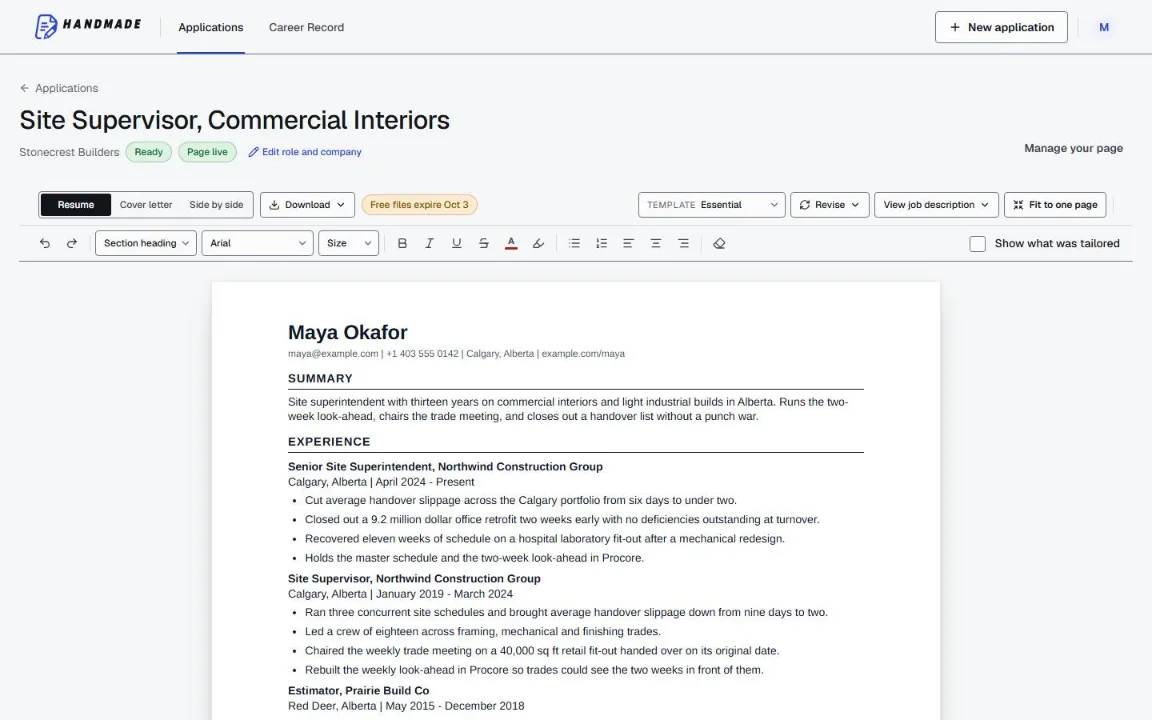
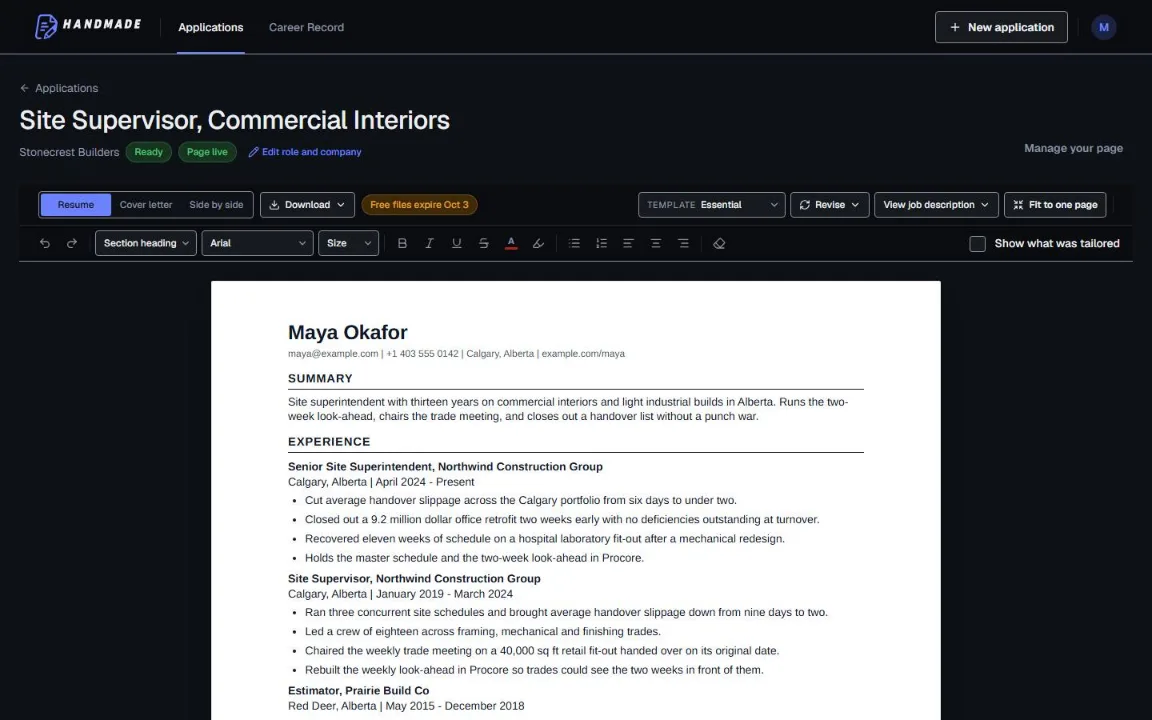
Keep your full work history in one Career Record, then tailor the top of your resume for the role you want. You can edit every line before downloading a format-checked PDF or DOCX.
2 complete application sets free, at the same quality as a paid plan. No card required.